

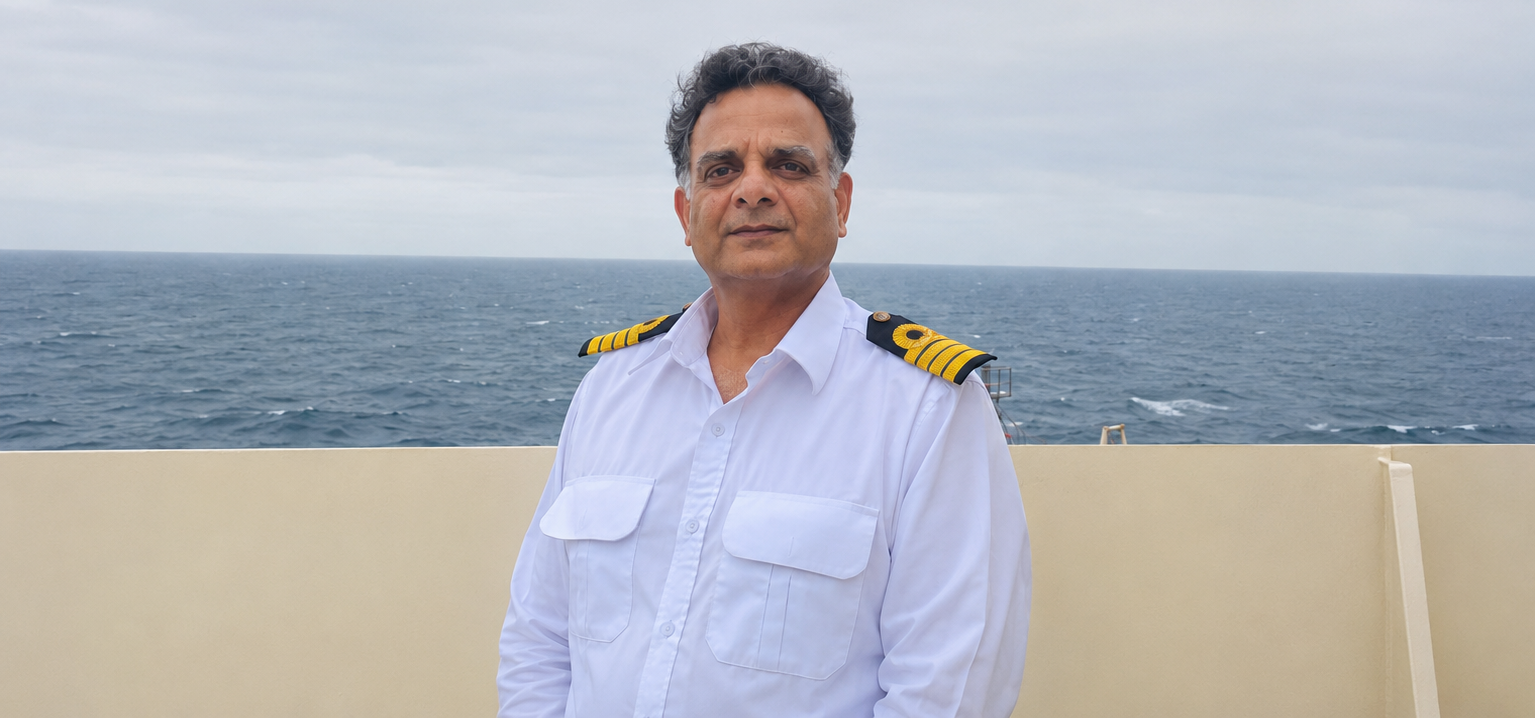
From engine room watchkeeping to mentoring the next generation, Senior Chief Engineer Shree Dhar Pandey reflects on leadership, safety, resilience, and the lessons learned across more than thirty years at sea.
Some maritime professionals are remembered for the ships they sailed on. Others are remembered for the people they helped shape along the way.
After more than three decades at sea, Senior Chief Engineer Shree Dhar Pandey has come to believe that while machinery, technology, and procedures are essential, the true strength of any operation lies in the people behind them.
A graduate of the Marine Engineering Research Institute (MERI), formerly known as the Directorate of Marine Engineering Training (DMET), Pandey has spent over thirty years navigating the challenges of shipboard operations and technical leadership. Since joining Mitsui O.S.K. Lines (MOL) in 1997 and becoming Chief Engineer in 2004, he has worked across an exceptional range of vessel types, including VLCCs, VLGCs, VLECs, ammonia carriers, oil tankers, container ships, car carriers, dry bulk carriers, and semi-container vessels. His experience has taken him from the engine room to shore-based technical management, giving him a rare perspective on both operational excellence and the human factors that influence safety, performance, and leadership.
In 2025, he was honoured with the MOL Presidential Award in recognition of his contributions to safe operations and the development of future seafarers—an achievement that reflects not only technical expertise, but also a long-standing commitment to mentorship and professional growth. Today, as an Advisor to Strive High, he continues to support the development of safer, more resilient, and more capable maritime professionals.
In this Seafarer Month feature, Pandey reflects on the realities of life below deck, the lessons learned through three decades of engineering leadership, the importance of listening and learning, and why the future of maritime will depend as much on people as it does on technology.
Thirty years at sea as a marine engineer is not a career—it is a calling. What was the moment early in your journey when you knew this profession had chosen you as much as you had chosen it?
It wasn’t one moment. It built up over time.
What kept me going, voyage after voyage, was the quiet satisfaction of seeing a ship arrive safely and knowing the machinery I had looked after had carried her there. That feeling never got old. Every problem I solved made me sharper, and every young engineer I worked with gave me something back. The rewards I value most aren’t the certificates on the wall. They are the trust people placed in me, and the knowledge that lives were safer because of the work we did. After a few years of that, you stop asking yourself whether this is the right job.
You just know it is, and you keep going.

Throughout your journey, was there a turning point where your perspective shifted from simply managing operations to leading people?
For a long time, I measured myself by the machinery. Were the engines running clean? Were the readings where they should be? Had the work been done right?
Then somewhere along the way, I realised the machinery was the easy part. The harder job was the people standing next to it.
These last several years, mentoring young engineers has given me more satisfaction than any technical fix ever did. Watching someone grow into the role and seeing their confidence settle in—that’s the work now. A safe voyage still matters, but knowing the next generation is carrying the right habits forward matters more.
“The machinery was the easy part. The harder job was the people standing next to it.”
You have witnessed maritime transition through three distinct eras—analogue, early digital, and now automation and data. Which transition tested your adaptability the most, and what did it demand of you personally?
The analogue world I trained in was about torque, current, and pressure—things you could feel. Early digital systems were an adjustment, but they still spoke a language close to the old one. Automation has been the harder shift. You’re not just diagnosing a pump anymore; you’re reading software, soft logic, and data. I had to be willing to unlearn things I had spent decades getting good at, and that isn’t easy at any age. It took humility and a fair bit of patience with myself.
What carried me through wasn’t really technical. It was sitting with younger engineers, learning from them while I taught them. That kept the work alive for me.
The engine room is often called the heart of the ship. What realities of engine room life do people outside the maritime world rarely see or understand?
The heat is the first thing nobody warns you about properly. Then the noise—constant, layered, and never really quiet. The smell of fuel and oil gets into your clothes, your skin, and your memory.
People imagine ships and picture the bridge or the deck. They don’t picture the spaces below where the actual work happens, where a missed reading can ripple through the whole vessel. There’s the watchkeeping that doesn’t stop because you’re tired and the troubleshooting on a deadline that doesn’t care about your shift.
And then there’s the closeness you build with the people working next to you, because nobody else really understands what it’s like down there.
You have sailed across a wide range of vessel types. Which vessel type challenged you the most, and why?
The ethane carriers, without question.
My organisation was one of the early ones to operate them, which sounds exciting in hindsight, but at the time it mostly meant there were no records to lean on and no veterans to call. Cryogenics is a different animal. The safety envelope is unforgiving, the protocols are unique, and a lot of what we know now had to be figured out by people like us, sometimes the hard way.
It tested everything—patience, judgement, and the nerve to lead a team into work where the manual was still being written. We supported each other, compared notes, and built the knowledge as we went.
There are moments at sea when experience tells you one thing and the procedure says another. Has there been a situation where your instinct as an engineer led you in a direction the manual did not anticipate—and what did that teach you?
Procedures are the backbone of how we keep ships safe. I won’t ever argue with that. But the sea has a way of producing situations the manual didn’t quite imagine, and in those moments what you have left is what your ears, your hands, and your years have taught you.
A vibration that’s slightly off. A sound that wasn’t there yesterday. The book can’t tell you about the one your ship is making right now.
A good marine engineer knows when to follow the procedure to the letter and when to also listen—to the machinery, to the team, and to the gut feeling that says, “look again.”
That balance is what I most want the younger ones to learn.
“The sea has a way of producing situations the manual didn’t quite imagine.”

You have spoken about safety being shaped not only by technical excellence but also by human awareness. In your experience, what behaviours create a strong safety culture onboard?
The most dangerous thought on a ship is, “It won’t happen to me.”
It rarely gets said out loud, but you can see it—in the shortcut taken, the check skipped, or the assumption made. Complacency doesn’t announce itself. It just slowly replaces vigilance with routine.
A strong safety culture is built by people who refuse to let that happen. People who keep asking questions even when everything looks fine, who hold themselves and each other accountable, and who treat every voyage like it’s the first.
Maintained machinery and good procedures matter, but they don’t save you on their own. A crew that stays alert and never confuses familiarity with safety—that’s what keeps ships and lives intact.
“The most dangerous thought on a ship is: ‘It won’t happen to me.'”
Have you ever seen a situation where procedures were followed correctly, yet something still went wrong? What did that experience teach you?
Yes, more than once.
You can do everything by the book and still have something fail, because the book is written for the situations someone has already seen. The sea, weather, wear, fatigue, or an unlucky combination of small things don’t always cooperate with the checklist. What those moments taught me is that compliance isn’t the same as safety. They overlap, but they aren’t the same.
The crews who came out well were the ones paying attention. They noticed the small change, asked the awkward question, and didn’t assume the green light meant green. Follow the procedure, always. But keep your eyes and your judgement switched on.
“Compliance isn’t the same as safety.”
Many maritime incidents are investigated through systems and procedures, but what human behaviour do you think people still underestimate the most?
Investigations are good at finding what failed—the valve, the sensor, or the missed step. They’re less good at finding the mood the crew was in that day.
The truth is, most crews are well trained, most equipment is maintained, and most procedures are sound. What slips through is the human factor, and most often it’s that quiet form of complacency where someone’s mind is half elsewhere, or where they’ve done the task so many times, they stop really seeing it.
Safety isn’t only about systems. It’s about a culture where people feel responsible for each other, where someone will speak up when something feels off, and where nobody assumes the next person has already checked.
What is one leadership mistake you have seen repeated throughout generations of seafarers?
Leaders who treat the job as command only and forget the people they’re commanding.
I’ve seen it across generations. Once that human connection isn’t there, the juniors stop telling you things—small concerns, small mistakes, or things they aren’t sure about. And those are exactly the things you need to hear. The crew goes quiet, the leader feels in control, and then something happens that everyone could see coming except the one person who needed to.
Real leadership at sea is being approachable. It’s being someone people can talk to without rehearsing what they’re going to say. When that exists, mistakes become lessons. When it doesn’t, they become incidents.
“Real leadership at sea is being approachable.”
Across your career, what is one quality you have seen in exceptional seafarers that is rarely listed in job descriptions?
Listening. Real listening.
The best seafarers I’ve worked with weren’t necessarily the most technically gifted in the room. They were the ones who paid attention. They listened to the machinery, to their colleagues, and to what wasn’t being said. They didn’t rush to act. They took the time to understand what was actually happening, thought it through, and then moved decisively.
That patience under pressure is rare, and you can’t put it on a CV. You learn it through humility, through being wrong a few times, and through realising you don’t have to be the loudest person in the engine room to be the most useful one.
“The best seafarers I’ve worked with weren’t necessarily the most technically gifted in the room. They were the ones who paid attention.”

You were specifically recognised for your contribution to developing future seafarers—not just working alongside them. What do you do differently as a mentor that you believe traditional maritime training does not always provide?
Traditional training teaches them systems. I try to teach them how to think. Manuals and classrooms will build their competence, and that part is well covered. What gets less attention is confidence, judgement, and the ability to stand in front of a problem and trust yourself to work it out.
So I sit with them. I ask what they’re unsure about. I share the mistakes I made and the close calls I won’t forget—not as war stories, but so they know the real shape of the job. The thing I most want them to walk away with is the belief that they aren’t just operators. They are the people the ship will eventually rely on.
“Traditional training teaches them systems. I try to teach them how to think.”
Looking back at your own early years as a marine engineer, what is one mistake you made not because you lacked skill, but because you had not yet earned the experience to know better?
I was confident, and confidence without experience is its own kind of blind spot. I made up my mind about people too quickly. I didn’t listen as well as I thought I did. I assumed that knowing the theory meant I understood the situation, and a few times I was wrong about that in ways I still remember.
What I learned, slowly, is that the best engineers are the humble ones. They ask. They listen. They take other people’s perspectives seriously, even when they think they already know the answer. Skill on its own only gets you so far. The rest comes from years of being around people who are happy to put you right when you need it.
Today’s younger workforce is entering maritime with different expectations and working styles. What do you think experienced professionals can learn from them as well?
They’re quick with technology in a way my generation had to work at. Automation, data, and software—they don’t find it intimidating, they find it natural.
That’s a real gift to the industry, and we should learn from it instead of being uneasy about it. Where I think we can offer something back is the fundamentals. Listening to a machine. Knowing when a procedure exists for a reason you can’t see yet. The instinct that comes from time on watch.
Neither side has the full picture on its own. The young engineers keep us moving forward. The experienced ones make sure we don’t lose the ground beneath our feet.
“The young engineers keep us moving forward. The experienced ones make sure we don’t lose the ground beneath our feet.”
Workforce retention is one of the industry’s quietest crises. From your three decades of experience, what actually keeps a seafarer committed to the profession long-term—and what slowly drives them away?
I stayed with the same organisation for twenty-nine years, so I have a fairly direct view on this. It wasn’t the salary that kept me, and I don’t say that lightly, because pay matters. What kept me was the feeling that the company actually cared—about me, about my family back home, and about whether I was okay.
That sense of being seen is what people stay for. What drives seafarers away isn’t usually one big thing. It’s the quiet erosion. Feeling invisible. Feeling that nobody notices the work. Feeling that wellbeing is a slogan and not a practice.
The companies that figure that out keep their crews.
“What drives seafarers away isn’t usually one big thing. It’s the quiet erosion.”
Having worked both onboard and ashore, if you had to clear one misunderstanding that ships and shore teams often have about each other, what would it be?
That the other side has it easier. Onboard, you have the relentless side of the job—the conditions, the responsibility, and the fact that the machinery doesn’t care that it’s three in the morning.
Ashore, it’s a different pressure. Regulators, clients, coordination across time zones, and accountability with no machinery to hide behind.
Neither is the comfortable seat. In well-run organisations, that mutual respect tends to be there, and you can feel the difference. The ship trusts the office, the office trusts the ship, and the work flows. Where it’s missing, both sides waste energy resenting each other for problems neither created.
Neither half of this industry succeeds alone.

Recent developments around the Strait of Hormuz have once again shown how quickly geopolitical events can reshape maritime operations. From your shipboard and shore-based experience, what should organisations be doing—both for operational preparedness and for the confidence and wellbeing of the people onboard—when situations like this unfold?
Two things, and they’re not equal in how often they get talked about. The operational side is the obvious one. Reroute, reassess, run the risk analysis properly, and adapt the commercial side to the situation rather than the other way around. The less talked about side is the people.
Crews onboard are reading the news too. They have families watching headlines and asking questions. The companies that handle these moments well are the ones that put crew safety ahead of schedule, communicate honestly about what they’re doing and why, and don’t make people feel like cargo.
I’ve seen organisations reshape entire business models to keep their people out of harm’s way.
“The companies that handle these moments well are the ones that put crew safety ahead of schedule.”
After more than three decades in maritime, what continues to inspire you to contribute to the industry?
Mostly the young engineers. Passing on what I’ve learned the wins, the mistakes, and the things I wish someone had told me—that’s what keeps me engaged. I’m also moved by the trust placed in us. Every safe passage is somebody’s family back home, even if we never see them.
And I’m fortunate to have worked where good work is actually noticed. Not just paid for, but acknowledged.
That kind of recognition matters more than people realise.
The next generation of marine engineers will face challenges your generation never encountered—autonomous systems, climate mandates, geopolitical disruption at sea. What is the one thing you believe they will need that no training programme can give them?
Resilience.
Technical skills they can study. Resilience is something else. The steadiness to keep your head when technology outruns the procedures. The spine to hold the line on safety when commercial pressure pushes the other way. The patience to keep working when the world keeps shifting around the ship.You don’t get that from a course. You build it through experience, through good mentors, and through being tested.
“Technical skills they can study. Resilience is something else.”
Across more than three decades at sea, Shree Dhar Pandey has witnessed extraordinary change in the maritime industry. He has worked through the transition from analogue systems to automation, sailed on pioneering vessel types, led teams through operational challenges, and helped shape the development of future engineers.
Yet despite all that change, one message runs consistently through his reflections: maritime excellence is never built on technical expertise alone.
Safety depends on vigilance. Leadership depends on trust. Learning depends on humility. And long-term success depends on people feeling valued, supported, and willing to look out for one another.
Whether discussing safety culture, mentoring young engineers, workforce retention, or navigating uncertainty, Pandey repeatedly returns to the same principle—the human element remains at the centre of every successful operation.
As the next generation enters an industry shaped by automation, new technologies, and evolving global challenges, the lessons shared through experience remain as valuable as ever.
Because while ships, systems, and technology will continue to evolve, the qualities that sustain great maritime professionals endure far longer.