

When The Voyage Ends, Who Are You? The Emotional Journey from Life at Sea to Life at Home
NOTE FROM THE EDITOR
There is a moment many seafarers imagine long before their voyage ends. The moment they step ashore, see their family waiting, hear familiar voices and finally feel that they are home. After months of working at sea, homecoming can feel like the reward for everything they have endured.
But what happens after the reunion?
Life at home may have continued in ways the seafarer has not been part of. Children have grown, routines have changed, relationships have adapted and responsibilities have shifted. The person returning may be carrying experiences that are difficult to explain, while the people waiting at home may have their own stories of the months apart. And somewhere between the happiness of being together and the reality of adjusting again, an unexpected feeling can emerge: I am home, but I am still finding my place. Returning home is often treated as the end of a voyage. Yet, for many seafarers, it marks the beginning of another journey one that takes place within relationships, emotions and the process of finding a sense of belonging again.
The World Health Organization reminds us that mental health is shaped not only by what happens within us, but also by the social, economic and environmental conditions in which we live. Our relationships, daily experiences and sense of connection all matter.
Leadership, Culture & Mental Wellbeing. This October, as we reflect on mental health and wellbeing, we turn our attention to a part of seafaring that is often overlooked: the emotional transition between life at sea and life at home. We explore the anticipation of returning, the challenges of reconnecting, the identities seafarers carry, and the emotional weight of preparing to leave again.
Because coming home is not always a simple return to where we left off.
“Coming home is not always a simple return to where we left off.”
Sometimes, it is the beginning of learning how to belong again.
Warm Regards,
Ms. Suganya Selvaraj
Marketing & Communications Manager
Strive High Pte. Ltd.
Before we explore what happens when a seafarer returns home, let us begin with the moment they have been imagining for months—the homecoming itself.
Because sometimes, the reality of returning is more complicated than the picture we carry in our minds.
THE HOMECOMING WE IMAGINE
The moment we have been waiting for. For months, the thought of going home can become a quiet source of motivation. A seafarer counts the days until the end of the contract, imagines the first embrace, the familiar sounds of home, a meal with family, or simply waking up without the ship moving beneath them.
Homecoming becomes more than a date on the calendar. It becomes something to look forward to when the days onboard feel long. And when the day finally arrives, the happiness can be overwhelming. But the picture we carry of returning home is often shaped by anticipation. We imagine the reunion, the relief and the feeling that everything will fall back into place. We may not spend as much time imagining what comes after the first embrace.
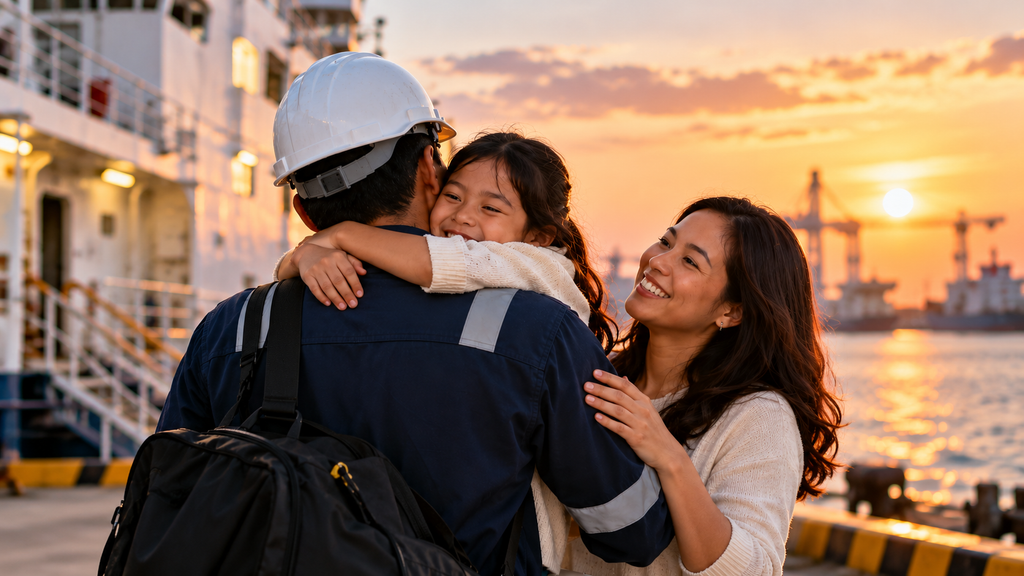
The transition back to everyday life can be more complicated than expected. The CSIRO’s Mental Health and Wellbeing at Sea Strategy recognises that returning to family, colleagues and friends after a long voyage can be difficult. Seafarers may carry high expectations of homecoming, only to find that the reality feels different.
But the pressure of expectations does not begin at home. It can follow a seafarer throughout the voyage. Onboard, there may be expectations to perform, remain dependable, take on responsibilities and progress professionally. At home, there may be expectations to reconnect, provide, participate in family life and make up for the time spent away. In both places, a seafarer can feel caught between what others need and what they are personally able to give.
Sometimes, the burden is not simply about meeting expectations. It is about carrying them from one place to another, with little time to consider what the transition means for oneself.
“The homecoming we imagine and the homecoming we experience are not always the same.”
There is a reason for this. Life onboard follows its own rhythm: watches, responsibilities, routines and a close-knit environment where each person has a role. At home, the rhythm may be entirely different. Family members have developed their own routines, and the seafarer must find a way to become part of them again. The happiness of returning is real. So is the adjustment that may follow. Perhaps we need to make more room for both.
A homecoming does not have to be perfect to be meaningful. It does not have to resolve every feeling of separation or restore every relationship to exactly how it was before. Sometimes, it is enough to arrive, reconnect gradually and allow everyone time to adjust.
Because the end of a contract does not always mean the end of the emotional journey. And sometimes, the first sign of that journey is subtle. The home is familiar. The people are familiar. Yet something feels different. Because while the seafarer was away, home did not stand still. Neither did the person returning.
WHEN HOME FEELS DIFFERENT
The house is familiar. The voices are familiar. The people you have missed for months are finally beside you. Yet, somewhere in the middle of an ordinary day, you realise that something feels different.
Perhaps the family has developed routines that continued while you were away. Perhaps your children have grown more independent, or your partner has become accustomed to managing responsibilities alone. You may have imagined returning to the life you left, only to discover that life has moved forward—and so have you. This does not mean that the reunion has failed. It means that returning home is also a process of adjustment.
During a long voyage, seafarers become accustomed to a particular rhythm of life. Work, rest, responsibilities and relationships onboard create a familiar structure. Returning ashore means stepping into a different rhythm, one that may feel less predictable than expected.
The CSIRO’s Mental Health and Wellbeing at Sea Strategy recognises that returning to domestic and professional life after a long voyage can be challenging. It notes that expectations of homecoming may not always match the reality of life ashore, and that family responsibilities can feel overwhelming after an extended absence.
“The transition back into domestic and professional life, particularly following a long voyage, can be a difficult one.”
— CSIRO, Mental Health and Wellbeing at Sea Strategy
There can be an unspoken expectation that returning home should feel effortless. After all, this is the place you have missed. These are the people you have wanted to be with. But emotional adjustment does not always follow the same timeline as physical arrival.
A seafarer may need time to rest, reconnect and become familiar with everyday life ashore. Family members may also need time to adjust to having someone back in the household. Both experiences can be true at once: the joy of being together and the difficulty of finding a new rhythm.
Perhaps the most helpful thing we can do is allow that adjustment to happen without treating it as a problem that must be solved immediately. Because home is not only a place we return to. It is a relationship we continue to build. And sometimes, even after the routines begin to feel familiar, another kind of distance can remain.
A seafarer may be physically present at home, sharing meals and conversations, while part of their mind is still carrying the experiences of life at sea. What does it mean to be home, yet still feel somewhere else?

PRESENT AT HOME, STILL AT SEA
The ship is no longer beneath your feet. The familiar faces are around you. You are sharing a meal, listening to stories, and catching up on the months you have missed. But sometimes, a part of you is still at sea.
It may be the habit of waking at a particular hour. The instinct to remain alert. The quietness after a demanding watch. Or the thoughts that return to a difficult moment onboard, even when the people you love are sitting beside you. Coming home changes the setting. It does not necessarily change your state of mind overnight.
For some seafarers, the transition can be complicated by experiences that are difficult to explain to people who have not lived through them. Research on maritime mental health has identified prolonged separation from family, demanding work, poor sleep, and limited social support among factors that can affect wellbeing. These experiences may continue to shape how someone feels and relates to others after the voyage.
A seafarer may need time to become part of the home’s everyday rhythm again. A partner may be waiting for conversation and closeness. Children may want attention immediately. The returning seafarer may want those same things, but feel unsure how to move from the routines of shipboard life into the pace of home. That difference can be misunderstood. Silence may look like distance. Tiredness may be mistaken for disinterest. A person who has been looking forward to home may still need space to settle.
The same distance can exist in friendships, too. For many seafarers, the journey towards a higher rank involves years of professional preparation. Vacation time may be spent attending courses, preparing for examinations, and completing the training required for higher-grade licences or other professional qualifications. While friends ashore may use their time off to socialise, a seafarer may be investing that time in the next step of their career.
Over time, friendships can become less frequent. Invitations may stop arriving, and the reasons behind a seafarer’s limited availability may not always be understood. What is a commitment to professional growth can sometimes be mistaken for being egoistic, distant, or uninterested in maintaining friendships.

The irony is that while seafarers are working hard to shape their future, their social connections may quietly fade. And when they finally return home, they may find that the people they once felt close to are no longer as present in their lives. This can create a different kind of loneliness—one experienced not at sea, but on land.
“What looks like distance may be a life spent preparing for the next step.”
And sometimes, the loneliness runs deeper than fading friendships. A seafarer may be surrounded by family, colleagues, or friends ashore and still feel that no one fully understands the world they have come from. The demands, routines, responsibilities, and experiences of life at sea can be difficult to explain to someone who has never lived them.
This can also become an identity challenge. Onboard, a seafarer may be defined by their rank, expertise, responsibilities, and the role they play within the vessel’s operations. Ashore, those familiar markers may not carry the same meaning. They may find themselves moving between two worlds, feeling fully understood in neither.
The question can become more personal: Who am I beyond my rank, my responsibilities, and the life I lead at sea? For some, finding an answer is part of the emotional adjustment of returning home.
“You can be surrounded by people and still feel that no one understands the world you have come from.”
A study of seafarers’ transitions describes life at sea and life at home as distinct phases, with readjustment taking place as people move between them. The cycle of departure, time onboard, and return is not simply a change of location; it involves repeated changes in everyday life and relationships.
Being home is a moment. Feeling at home again may take time. That is why reconnection does not always begin with a grand conversation. Sometimes it begins with patience: allowing space for quiet, sharing ordinary routines, and asking how the other person is experiencing the return. It also means recognising that the family has been adjusting during the absence, too.
The aim is not to recreate the exact life that existed before departure. It is to find a way forward together, with room for the changes each person has experienced. Because presence is more than being in the same room. It is the gradual work of becoming emotionally available to one another again.
As seafarers return, they do not step into just one role. They may be a partner, parent, son or daughter, friend—and a professional preparing for the next voyage. How do these different roles meet, and what happens when the person returning home is still discovering how to inhabit them?
THE MANY ROLES WE RETURN TO
At sea, your role is clear. You know your responsibilities, your routine, and the people who depend on you to do your job. At home, the picture may be less straightforward.
You return as a partner, a parent, a son or daughter, a friend. You may be expected to join decisions, take part in family routines, or simply be present in ways that were not possible while you were away. Yet, during your absence, the household has continued to function. Roles have shifted. New routines have taken shape. People have learned to manage without you.
Returning can bring a quiet question: Where do I fit now?
Research on seafaring families has explored this experience of “role displacement”—when seafarers return home and feel unnecessary, out of place, or like outsiders in family routines that developed during their absence. The same research recognises that partners have also carried responsibilities and adapted while the seafarer was away. These adjustments can create tension, even when both sides have been looking forward to the reunion.
This is not about deciding whose way of managing the home is right. It is about recognising that both people have been living, adapting, and making decisions in different circumstances. These differences can also place pressure on relationships. Expectations about how time at home should be spent, how financial decisions should be made, and how household responsibilities should be shared may not always align. A seafarer may feel that the sacrifices made during the voyage are not fully recognised, while a partner may feel that the responsibilities carried during the absence are not fully understood. Both may be trying to do what is best for the family, yet experience the situation very differently.
Sometimes, misunderstandings arise not because people care any less, but because they have been managing different realities for months. Rebuilding understanding requires acknowledging what each person has carried and finding a way to share responsibilities again.
A returning seafarer may want to help, but find that the family already has a way of doing things. A partner may welcome support, while also needing time to share responsibilities again. Children may need time to become comfortable with a parent’s presence after a long absence. These are not signs that the relationship has failed. They are reminders that returning home involves more than resuming a role. Sometimes, the role itself has changed.
“Family life is not paused while a seafarer is at sea. It keeps moving.”
A useful place to begin is with conversation rather than assumption. What has changed while you were away? What would help now? Which routines should remain, and which can be built together? The answer may not arrive in one conversation. But making room for each person’s experience can help turn the return from a negotiation of roles into a renewed sense of partnership.
Because family life is not paused while a seafarer is at sea. It keeps moving—and homecoming is an opportunity to find the rhythm together again.
Even as seafarers begin to settle into family life, the next departure can start to take shape in the background. The countdown may begin again, bringing anticipation, practical preparation, and sometimes worry. How does a family make space for the present when another goodbye is already approaching?
WHEN THE NEXT DEPARTURE BEGINS
The first days at home can feel full of possibility. There are plans to make, people to see, and moments to reclaim. But gradually, another date begins to appear on the calendar. The next joining date. For some seafarers, the thought of leaving again arrives before they have fully settled back in. A family gathering may carry the quiet awareness that this time together is limited. A child’s ordinary question “When are you going again?” can make the next departure feel suddenly close.

The cycle of returning and leaving is not only a matter of travel arrangements. It can shape how families experience time together. Research into seafarers’ wellbeing has identified employment-related concerns at home, including leaving again for the next contract and uncertainty about future work, among sources of sadness.
The next voyage may bring mixed feelings. There may be pride in the work, responsibility toward the family, and commitment to a career. There may also be reluctance to leave, worry about missing important moments, or a wish for more time at home. These feelings can exist together. For families, preparation for departure can begin emotionally before the bags are packed. Plans may be made around the absence. Children may be reminded of the upcoming goodbye. Partners may begin anticipating the responsibilities they will soon manage alone.
“The voyage begins long before the ship leaves port.”
It can be tempting to treat this period as a countdown: make the most of every day, complete every task, resolve every disagreement before departure. But time together does not need to be perfect to be meaningful. Sometimes, what helps is a more honest conversation about what is coming. What will be difficult this time? What support might be needed? How can the family stay connected when the voyage begins?
The aim is not to remove the sadness of leaving. It is to make sure that the next departure is not something everyone has to carry silently. Because the voyage begins long before the ship leaves port. For many families, it begins with the first conversation about goodbye.
If the emotional journey begins before departure and continues after return, support cannot be limited to the time onboard. It must also make room for the transitions between sea and home. What might it look like to prepare for those transitions with the same care given to the voyage itself?
MAKING SPACE FOR THE TRANSITION
A return home is often treated as a date on the calendar. The contract ends, the journey is completed, and the seafarer arrives. But the emotional transition may not follow the same schedule.
There may be practical things to organise, family routines to re-establish, and expectations to navigate. Some seafarers may feel ready to reconnect immediately. Others may need time to rest, reflect, or find their rhythm again. Neither experience has to be treated as the only “right” way to return.
The CSIRO’s Mental Health and Wellbeing at Sea Strategy recognises that returning to domestic and professional life after a long voyage can be difficult. It also highlights that expectations about coming home may not always match the reality of the return. A transition deserves more than a date. It deserves understanding.
That understanding can begin with small, intentional steps. Before returning, seafarers and their families can talk about what they are looking forward to—and what might feel challenging. After arrival, they can allow time for rest and reconnection instead of expecting every routine to fall into place at once.
Families can make space for honest conversations without assuming that everyone has experienced the separation in the same way. Seafarers can share what they need, even when the answer is simply, “I need a little time to settle.” And when the transition feels persistently difficult, reaching out for support can be part of looking after oneself—not a sign of weakness.
“A transition deserves more than a date. It deserves understanding.”
Support should not begin only when someone is struggling. It can be built into the journey: before departure, during the voyage, and after returning home. The maritime mental health literature also points to the importance of family communication, supportive relationships, and accessible support systems.
The aim is not to make every homecoming effortless. It is to recognise that returning is an experience in its own right, one that deserves care from both the individual and the people around them. Because a voyage may end when a ship reaches port. The transition home can continue long after.
Understanding the emotional journey between sea and home is important. But awareness alone does not always change how people respond. What helps turn that understanding into everyday behaviour—in conversations, relationships, and the way organisations support their seafarers?
FROM AWARENESS TO BEHAVIOUR
The Strive High Perspective
Understanding the emotional journey between sea and home is an important first step. But awareness becomes meaningful when it begins to influence how people respond.
A seafarer returning home may need patience rather than assumptions. A partner may need acknowledgement for the responsibilities carried during the absence. A child may need time to reconnect. And a workplace may need to recognise that the end of a contract does not necessarily mean the end of the emotional demands of a voyage. These moments are shaped by behaviour: how we listen, how we communicate, how we respond to uncertainty, and whether we make room for another person’s experience.
“Wellbeing is not only about helping people cope with life at sea. It is also about recognising the lives they return to.”
At Strive High, we believe that strengthening people and performance begins with understanding the human element. Our work in behavioural skills development focuses on areas such as emotional intelligence, communication, leadership, and wellbeing—skills that influence how people relate to one another, both onboard and ashore.
In the context of homecoming, this can begin with something simple: asking rather than assuming.
Instead of “You’re home now, so everything should be fine,” consider, “How has the transition been for you?” Instead of interpreting silence as distance, create an opportunity for conversation. Instead of expecting family routines to return immediately, recognise that everyone may be adjusting.
These are small behavioural shifts, but they can change the quality of a relationship. They help make emotional experiences easier to express and reduce the pressure to appear fine when someone is still finding their footing.
For maritime organisations, the same understanding can extend beyond the vessel. Support for seafarers can include preparing them for the emotional realities of returning home, encouraging open conversations, and making support accessible across the wider seafaring cycle.
Because wellbeing is not only about helping people cope with life at sea. It is also about recognising the lives they return to. Through practical, research-informed behavioural learning, Strive High works to help individuals and teams translate understanding into everyday actions. The goal is not to prescribe how every homecoming should feel, but to strengthen the skills and relationships that make transitions easier to navigate.
The voyage may be part of a seafarer’s identity. It does not have to be the whole of it.

We have explored the anticipation of coming home, the adjustment that follows, and the next departure waiting in the distance. Yet beneath these experiences lies a larger question: when a seafarer returns, what does it mean to feel not only home, but understood?
FINAL REFLECTION
WHEN THE VOYAGE ENDS, WHO ARE YOU?
A seafarer’s return home is often measured in days: the days until the contract ends, the flight home, the reunion, and the time before the next departure. But the emotional journey does not always follow the calendar.
Some return home and settle into familiar routines with ease. Others need time to reconnect—with family, with everyday life, and with parts of themselves that have been shaped by months at sea. For many, the experience may be a little of both. There is no single way to come home.
The important thing is to make room for the reality behind the reunion. To recognise that families have changed and adapted during the absence. To understand that being physically present does not always mean feeling fully connected. And to remember that asking for support can be part of the transition, not a last resort.
Mental health is not only about what happens during the voyage. It is also shaped by the relationships, responsibilities, and experiences that continue when the ship reaches port. Seafarers and their families deserve support that recognises this whole journey.
Perhaps the question is not simply, “When are you coming home?”
Perhaps it is also: “How are you finding your way back?”
Because the person who returns may not be exactly the person who left. And the home they return to may not be exactly the same either. That does not mean something has been lost beyond repair. It means there is an opportunity to understand one another again—to listen, to reconnect, and to make space for the changes that life at sea brings.
The voyage may shape who a seafarer becomes. But their story is also written in the relationships they nurture, the life they build ashore, and the moments in which they feel understood.
When the voyage ends, the journey of belonging continues.
LET’S CONTINUE THE CONVERSATION
Every seafarer’s journey home is different. Some find their rhythm quickly; others need time, understanding, and support.
At Strive High, we believe that meaningful wellbeing begins when we make space for these experiences—not only onboard, but also in the lives and relationships that seafarers return to.
Let’s continue creating conversations that recognise the human side of maritime life.
Explore how we support people, performance, and wellbeing through behavioural skills development at Strive High.
Because soft solutions can make a meaningful difference to tough, human challenges.