
With the exponential increase in the pace of change due to growing technology, increasing regulations, unpredictable political environment, etc., the challenges people face in day-to-day life are growing. Neuroscience has proven that uncertainty and increased stress can shut down the logical part of our mind as we focus on survival. When we are under pressure, we do or say things we usually don’t. We lose our ability to think straight and the ability to make better decisions. This is because strong emotions like anxiety, anger, and joy trip off our more evolved Human Brain, bypass the high-level thinking associated with it, and allows our primitive brain, ‘the emotional brain’, to take over. Emotions’ power overwhelms rationality. The realization (if at all it happens) happens much later, often when the damage is done. Yet, the pattern continues because most people accept it as a habit or behaviour they are born with or have made failed attempts to change the same. Some people blame it on destiny, some on circumstances, least realizing the power they possess – The Power Within!
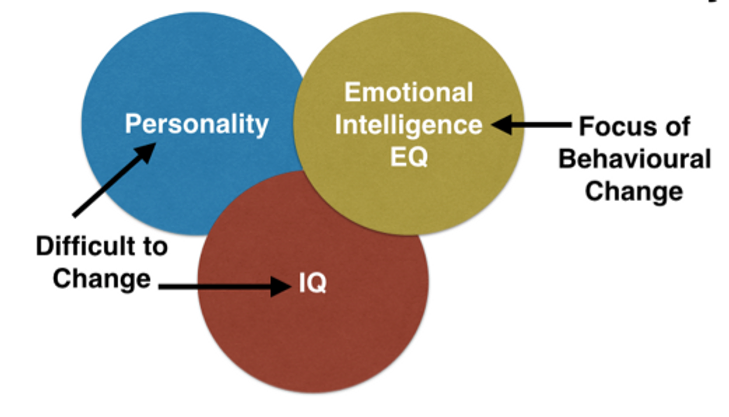
1) Cognitive Intelligence (IQ): our ability to plan, reason, and use logical deduction to solve problems. It refers to a person’s capability to apply abstract thinking while learning from and responding to the environment.
2) Personality: Our personality results from our preferences, such as our tendency towards extroversion, introversion, etc.
3) Emotional Intelligence (EQ): The ability to accurately identify and understand one’s emotional reactions and those of others. It also involves regulating one’s emotions to use them to make the right decisions and act effectively (Mayer, Salvoes & Caruso 1998).
Therefore, it is no surprise that The World Economic Forum has identified Emotional Intelligence as one of the top 10 skills required to succeed by 2020. It is important to note that Emotional Intelligence directly contributes to developing the rest of the nine skills.
Emotional Intelligence is quickly gaining prominence and acceptance in the business world because of its role in the development of organizational culture and its impact on the performance of teams and individuals. The common denominator can help people tick, stick, and click. It is the answer to some of the most significant challenges organizations face – motivating employees, retaining top talent, building collaboration, and boosting productivity. On an individual level, it is the factor that can help people strive & thrive in their respective professions. It is indeed the Game Changer!
Preeti Dubey Founder, Director
STRIVE HIGH – Soft Solutions For Tough Problems ! Like us on Facebook , Follow us on Twitter