
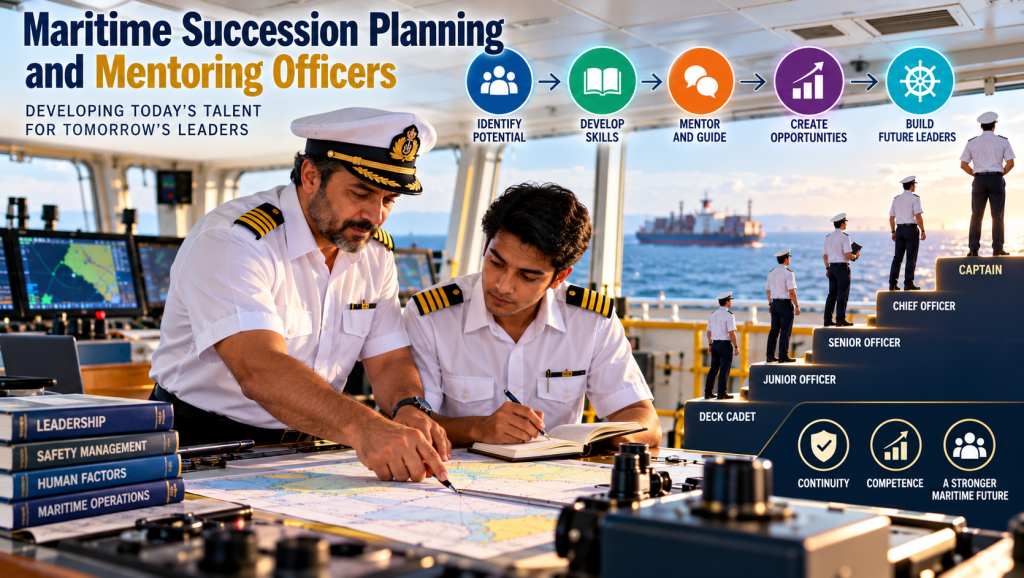
Maritime succession planning is the practice of knowing, before a vacancy appears, who is ready for the next rank and what they still need — and mentoring is the mechanism that gets them there. Without it, promotion decisions default to seniority and availability, which is how technically capable officers end up in command without the behavioural preparation the role demands.
Most shipping companies can state their officer shortfall for the next twelve months. Far fewer can name, per vessel, which second officer is ready for chief officer and which specific gap is holding them back. That second question is what succession planning answers.
Why seniority is a poor promotion signal
Sea time and certification confirm that an officer has met a technical standard. They say nothing about whether that officer can delegate, give difficult feedback, manage a multinational crew, or hold a safety position against commercial pressure.
Because those behaviours are never formally assessed, they are assumed. The assumption usually holds for competence and fails for leadership, which is why the first contract after promotion is where most difficulty appears — and why it often surfaces as crew conflict or micromanagement rather than as a visible competence problem.
Assessing behaviour alongside technical readiness, through a behavioural competency assessment, converts the assumption into evidence.
What a maritime succession plan contains
A plan that is actually usable has four parts:
- A competency framework per rank, defining the behaviours expected at second officer, chief officer and master, not only the certificates.
- A current readiness picture for each officer: ready now, ready in twelve months with specific development, or not on this track.
- Named development actions tied to the gap — not “needs leadership training” but “needs practice running pre-arrival briefings, with feedback from the master”.
- A review cycle, so readiness is reassessed rather than recorded once and forgotten.
The structure matters less than the discipline of revisiting it. A succession plan written during a consultancy engagement and never updated is an artefact, not a process.
Mentoring is where development actually happens
Courses transfer concepts. Mentoring transfers judgement, and judgement is the thing a new master most needs.
Effective shipboard mentoring is mostly a matter of deliberately handing over real decisions before the officer formally owns them. A master who lets the chief officer run the pre-arrival briefing, take the berthing plan, or handle a difficult conversation with a rating — and then debriefs it honestly — is building command capability in a way no classroom can.
What distinguishes mentoring from supervision is the debrief. Letting an officer do the task teaches execution. Asking afterwards what they considered, what they rejected and what they would change teaches judgement.
The cadet and junior officer problem
Cadets are frequently the most neglected group onboard, because mentoring them has no immediate operational payoff and everyone is busy. The cost lands years later as an officer shortage.
Companies that handle this well tend to do three unglamorous things: assign a named mentor per cadet rather than leaving it to goodwill, require a short structured conversation at fixed intervals, and make mentoring quality part of how senior officers are themselves appraised. The last one is decisive, because mentoring that is encouraged but never measured is the first thing dropped under workload.
The wider programme view sits in our guide to the crew development programme.
Retention is a succession issue
Seafarers leave for wages, but they also leave when they cannot see a route upward. A visible development path is a retention instrument, and it costs less than the wage escalation it substitutes for.
The reverse is also true: an officer who watches a less capable colleague promoted on seniority learns that performance is not the currency. That lesson spreads quickly and is expensive to reverse.
Ship and shore need the same picture
Succession planning fails when crewing ashore holds the database and the master holds the actual knowledge of who is ready. The vessel sees daily behaviour under pressure; the office sees certificates and availability.
Bridging that requires masters to contribute structured behavioural observations rather than general impressions, and crewing managers to treat those observations as data rather than opinion. Where both groups are trained in the same behavioural language, the assessment stops being contested. This is why Strive High delivers maritime leadership development to ship and shore teams together.
Measuring whether it works
Useful indicators, none of which is course completion:
- Proportion of promotions filled from an identified ready pool rather than external recruitment.
- Time from vacancy to a confident appointment.
- Retention of officers in the twelve months after promotion — a direct test of whether they were actually ready.
- Behavioural assessment movement between review cycles.
- Number of officers with a named mentor and a documented recent conversation.
The broader leadership context, including why command at sea differs from shore management, is covered in leadership at sea. Programme design and assessment support are available through our behavioural skills assessment service.
Frequently asked questions
What is maritime succession planning?
Knowing before a vacancy appears which officers are ready for the next rank and what specific gap remains. Without it, promotion defaults to seniority and availability rather than demonstrated readiness.
Why is seniority a poor basis for promotion?
Sea time and certificates confirm technical standards but say nothing about delegation, giving difficult feedback, managing multinational crews or holding a safety position under commercial pressure. Those behaviours get assumed rather than assessed.
What does a maritime succession plan contain?
A competency framework per rank covering behaviours as well as certificates, a current readiness picture per officer, named development actions tied to the specific gap, and a review cycle so readiness is reassessed.
How is mentoring different from supervision at sea?
Supervision checks execution. Mentoring hands over real decisions before the officer formally owns them, then debriefs what they considered and rejected, which is how judgement rather than procedure is transferred.
How do you measure succession planning results?
Promotions filled from an identified ready pool rather than external recruitment, time from vacancy to confident appointment, retention in the twelve months after promotion, behavioural assessment movement between cycles, and how many officers have a named mentor with a recent documented conversation.