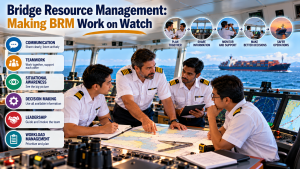

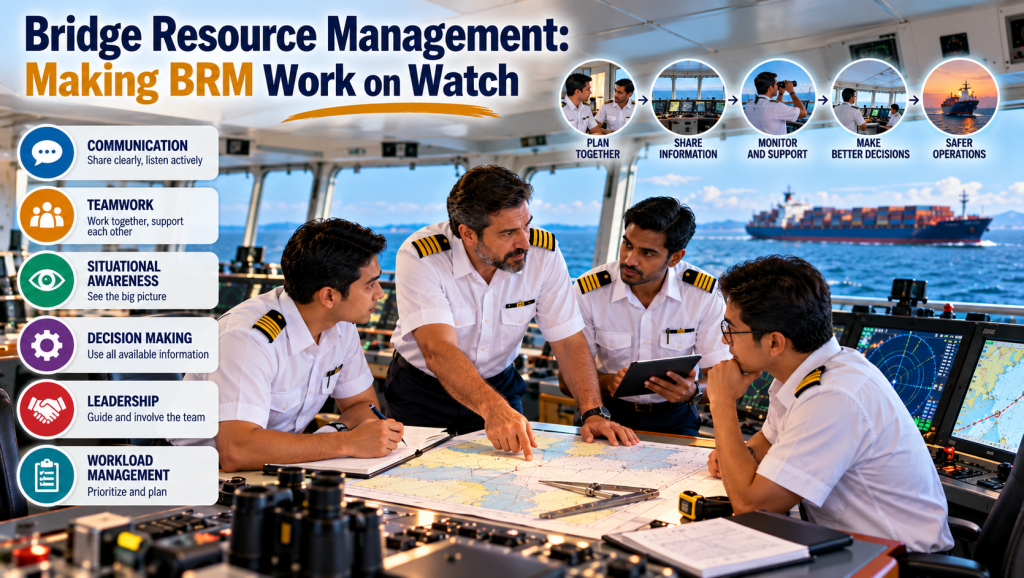
Bridge Resource Management is the practice of using every person, instrument and piece of information on the bridge as one coordinated system, so that no single officer’s error becomes the vessel’s error. It exists because most navigational incidents involve competent officers who had the information needed to avoid them, but where that information never reached the person making the decision.
BRM is sometimes treated as a certificate to be collected. Used properly it is a working method for the watch, and the difference shows in how a bridge team behaves in the ten minutes before a close-quarters situation.
What BRM covers
The core of BRM is the deliberate distribution of attention and authority across the bridge team:
- Shared mental model — everyone on the bridge holds the same picture of the plan, the traffic and what happens next.
- Explicit role allocation — who is conning, who is monitoring, who is communicating, stated rather than assumed.
- Closed-loop communication — instructions are read back and confirmed, so an unheard order is detected immediately. Our guide to closed-loop communication onboard covers the mechanics.
- Cross-checking — position, intention and instrument data verified by a second source rather than trusted.
- Challenge and response — a defined, non-confrontational way for a junior officer to question the officer of the watch or the master.
- Workload management — recognising when the bridge is saturated and redistributing before it fails.
Why technically strong bridge teams still fail
Three patterns recur in investigation reports.
Authority gradient too steep. A master with decades of experience and a second officer six months into the rank are not going to challenge each other symmetrically. Where the gradient is steep, the junior officer sees the developing risk, assumes the master has seen it too, and says nothing.
Plan continuation bias. Once a passage plan is committed to, the team unconsciously filters evidence that the plan is no longer appropriate. This is strongest under time or commercial pressure.
Attention collapse under load. In a busy approach, a bridge team can narrow onto a single task — a pilot ladder, a VHF exchange — and lose the wider picture for the ninety seconds that mattered.
None of these are fixed by more navigational knowledge. They are fixed by team behaviour, which is what distinguishes BRM from technical refresher training.
The challenge-and-response problem
Every BRM course teaches that a junior officer should speak up. Few address why they do not. The reasons are rank, culture, uncertainty about whether the concern is real, and the fear of being wrong in front of the master.
A workable solution is a scripted escalation that removes the need to improvise under stress. Many fleets adopt a graded form:
- State the observation. “Master, the CPA on that contact is reducing.”
- State the concern. “I’m concerned we will be inside half a mile.”
- State the proposal. “I suggest we come ten degrees to starboard now.”
- Request a decision. “Master, do you agree?”
The value is that step four requires an answer. Silence is no longer a valid response, and the junior officer has not had to decide how assertive to be. This only functions where the master has visibly welcomed challenge beforehand, which is the link between BRM and psychological safety onboard.
BRM and ERM are the same discipline
Engine Room Resource Management applies identical principles to a different space: shared understanding of the plant’s state, explicit roles during a critical operation, read-back of instructions, and a route for a junior engineer to question a decision.
Where a company trains BRM and ERM separately with no common language, ship-wide coordination suffers during exactly the events that span both — blackout recovery, steering failure, fire. The wider framing sits in crew resource management training.
Making BRM stick after the course
BRM delivered as a five-day classroom module and never referenced again produces a certificate and little behaviour change. What sustains it:
- Pre-arrival briefings that actually allocate roles, rather than reading the plan aloud.
- Debriefs after demanding operations, including the ones that went well, asking what nearly went wrong.
- Masters who invite challenge in low-stakes moments, so the habit exists before a high-stakes one.
- Assessment of bridge team behaviour, not just individual competence — see behavioural competency assessment.
What good looks like
On a bridge where BRM is working, an observer notices that intentions are spoken aloud before they are executed, that the junior officer asks questions without hedging, that instrument readings are confirmed by a second source as routine, and that when the workload rises someone says so.
None of that requires new equipment. It requires a team that has agreed how it will work before the pressure arrives, which is the entire point of resource management training. Strive High delivers BRM and wider behavioural programmes to ship and shore teams as part of our maritime training from Singapore.
Frequently asked questions
What is Bridge Resource Management?
The practice of using every person, instrument and information source on the bridge as one coordinated system, so no single officer’s error becomes the vessel’s error. It covers shared mental models, role allocation, closed-loop communication, cross-checking and challenge-and-response.
What is the difference between BRM and ERM?
They are the same discipline applied to different spaces. Engine Room Resource Management uses identical principles for the machinery space, and problems arise when a company trains them separately with no shared language.
Why do experienced bridge teams still have incidents?
Three patterns recur: an authority gradient too steep for a junior officer to challenge the master, plan continuation bias that filters out evidence the plan no longer fits, and attention collapse under heavy workload.
How should a junior officer challenge the master?
Use a scripted escalation that removes improvisation under stress: state the observation, state the concern, state a proposal, then request a decision. Requiring an answer means silence is no longer a valid response.
How do you make BRM training stick after the course?
Pre-arrival briefings that genuinely allocate roles, debriefs after demanding operations including successful ones, masters who invite challenge in low-stakes moments, and assessment of bridge team behaviour rather than individual competence only.