

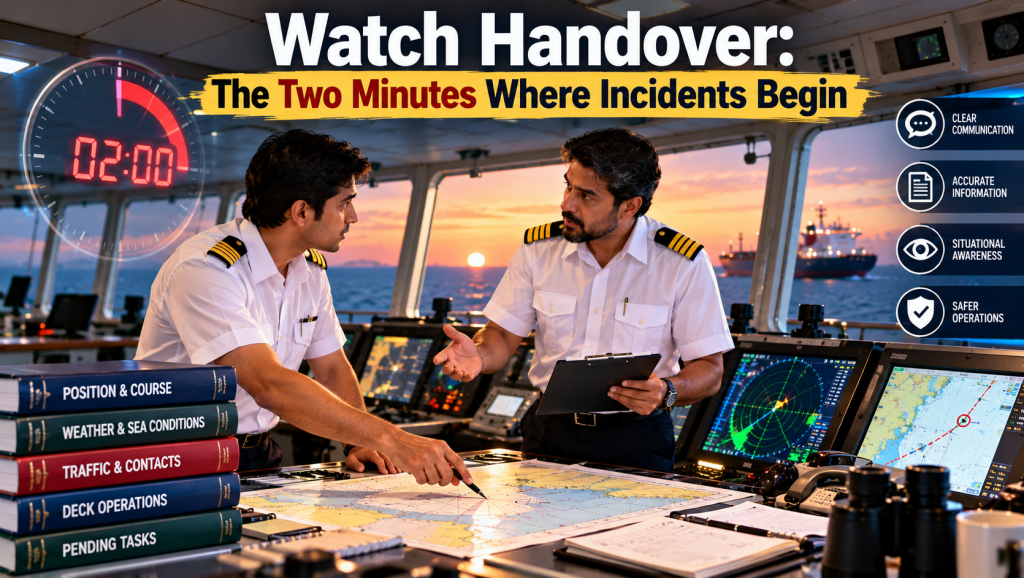
A watch handover is the transfer of a complete, shared picture of the vessel’s situation from one officer to another, and it is one of the highest-risk routine moments on any ship. Incidents cluster around handovers because the outgoing officer knows things that never get said, and the incoming officer accepts the watch believing the picture is complete.
The handover takes two minutes and happens several thousand times a year across a fleet. That combination — frequent, brief, and almost never audited — is what makes it worth examining.
Why handovers fail
The failure is rarely negligence. It is the ordinary mechanics of how people transfer knowledge under time pressure.
The curse of knowledge. The outgoing officer has watched a situation develop over four hours. They know which contact has been behaving oddly and which fishing vessel changed course twice. Much of that context feels too obvious to state, so it is not stated.
Social pressure to be quick. The incoming officer does not want to appear slow, and the outgoing officer wants to go to bed. Both are motivated to compress the handover, and neither will say so.
Fatigue on both sides. The outgoing officer is at their least articulate precisely when precision matters. The incoming officer may still be waking up. See our guidance on managing fatigue at sea.
No agreed structure. Where there is no format, handover content depends on personality. Thorough officers hand over thoroughly; others do not, and the variance is invisible until something goes wrong.
What a complete handover contains
A reliable handover covers state, intention and anomaly:
- Position, course, speed and the active passage plan leg, confirmed on the chart rather than described.
- Traffic picture, including any contact being monitored and why it is being monitored.
- Equipment status, with anything degraded, alarmed or suppressed stated explicitly.
- Standing orders and master’s night orders, confirmed as read.
- Expected events in the coming watch — waypoint, pilot boarding, traffic separation scheme, weather change.
- Anomalies — anything that felt unusual, even unresolved. This is the item most often omitted and most often relevant afterwards.
- Explicit acceptance. The incoming officer states that they have the watch, and the outgoing officer hears it.
That last point is not ceremony. Ambiguity over who holds the watch has caused incidents in the minutes when both officers believed the other was conning.
The anomaly item deserves special attention
Officers reliably hand over facts and reliably omit unease. “That contact has altered twice and I don’t know what he’s doing” is exactly the information the next officer needs and exactly the kind that sounds unprofessional to say.
Making unease a required field normalises it. Where an officer is expected to report what felt odd, the handover becomes a transfer of judgement rather than only of data — and the next officer starts their watch already watching the right thing.
Whether officers feel able to voice uncertainty depends on the climate the master has created, which is the practical overlap with psychological safety.
Read-back applies here too
A handover is a communication task, so the same discipline used for bridge orders applies. The incoming officer summarising the key points back — position, the contact being watched, the next event — surfaces misunderstandings in about fifteen seconds.
It feels redundant the first few times and then catches something. The technique is covered more fully in closed-loop communication for maritime teams.
Handovers in the engine room and between ship and shore
The same structure applies to engine room watch changes, where degraded equipment and suppressed alarms carry equivalent risk, and to the much longer handover between a departing and joining officer at crew change.
That crew-change handover is the weakest link in most fleets. A departing chief officer may hold months of context about cargo behaviour, a troublesome valve or a crew tension, and transfer almost none of it. Where companies require a written handover note covering the same three headings — state, intention, anomaly — that knowledge survives the crew change instead of leaving on the launch.
Auditing something that takes two minutes
Handover quality is easy to improve because it is easy to observe. A master or visiting superintendent sitting through three handovers learns more about a bridge team’s discipline than a document review will show.
Useful questions: was there a structure, or did content depend on who was speaking? Was equipment status stated or assumed? Was an anomaly mentioned? Did the incoming officer confirm acceptance aloud?
Behavioural observation of this kind is what a behavioural competency assessment is designed to capture, and it generates far more actionable findings than testing knowledge the officers already have.
A two-minute discipline worth training
Nothing in a good handover is difficult. It needs an agreed structure, permission to voice uncertainty, and a culture where taking the extra thirty seconds is read as professionalism rather than slowness. Strive High builds these habits into bridge and engine room team programmes as part of our maritime training delivered from Singapore.
Frequently asked questions
What should a watch handover include?
Position, course, speed and active passage plan leg confirmed on the chart; the traffic picture including any contact under monitoring and why; equipment status with anything degraded or suppressed stated; standing and night orders confirmed; expected events in the coming watch; any anomaly; and explicit verbal acceptance of the watch.
Why do watch handovers fail?
The outgoing officer omits context that feels too obvious to state, both officers are motivated to be quick, fatigue reduces precision exactly when it matters, and without an agreed structure handover quality depends on personality.
What is the most commonly omitted handover item?
Unease. Officers reliably transfer facts and reliably omit the sense that something felt odd but unresolved, which is often the information the next officer most needs.
Should the incoming officer read back the handover?
Yes. A fifteen-second summary of position, the contact being watched and the next expected event surfaces misunderstandings immediately, applying the same closed-loop discipline used for bridge orders.
How do you audit handover quality?
By observation. Sitting through three handovers shows whether a structure exists, whether equipment status is stated or assumed, whether anomalies are mentioned, and whether acceptance of the watch is confirmed aloud.