

A just culture in shipping is one where crew report mistakes and near misses without fear of punishment, while genuine recklessness is still held to account. It is the precondition for near-miss reporting, because a crew that expects blame reports only what cannot be hidden, and a fleet that only hears about incidents it cannot hide is managing safety with half the information.
Most shipping companies already have a reporting system. Far fewer have the culture that makes it produce useful data. The gap shows up in a familiar pattern: a vessel submits two near misses a quarter, all of them trivial, while the same fleet records serious incidents that nobody saw coming.
Why near-miss reporting matters more than incident reporting
An incident tells you what already went wrong. A near miss tells you what is about to go wrong, while it is still free to fix. For every serious event there are typically dozens of unreported precursors: a misread instruction, a shortcut on a lashing, a watchkeeper who nearly missed a contact.
Those precursors are the only early-warning data a fleet has. Suppressing them does not reduce risk, it just removes visibility of it.
What “just” actually means
Just culture is frequently misread as a no-blame culture. It is not. A no-blame culture cannot address a crew member who disables an alarm to avoid nuisance alerts, and crews lose confidence in a system that treats every act identically.
The workable distinction is between three categories:
- Human error — a slip or lapse by someone trying to do the job correctly. This is a system signal, not a discipline matter.
- At-risk behaviour — a shortcut taken because the correct method is slow, awkward or poorly designed. The response is to fix the condition, then coach.
- Reckless behaviour — a conscious disregard of a known, substantial risk. This is where accountability properly applies.
Applying the same response to all three is what breaks reporting. Crews quickly learn whether an honest error is treated as a lesson or a liability.
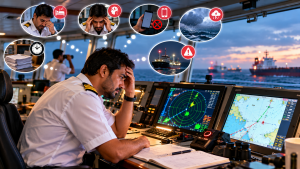
Why crews stay silent
When reporting volumes are low, the cause is rarely a form that is too long. In practice the reasons cluster:
- Fear that a report becomes a performance note, or affects a future promotion or contract.
- Belief that nothing will change, because previous reports produced no visible response.
- Reluctance to implicate a colleague in a small living environment, where the person named still shares the mess room.
- Uncertainty about what even counts as a near miss.
Only the last is a training problem. The first three are leadership problems, and they are the mechanism psychological safety training is designed to address: whether speaking up is safe in the first place.
What leadership behaviour makes reporting work
The single strongest signal is what happens to the first honest report. If a master thanks the reporter, acts on the condition, and tells the crew what changed, reporting rises. If the report produces silence, or worse a quiet reprimand, the system is finished regardless of policy.
Practical behaviours that sustain it:
- Close the loop publicly. Tell the crew what was reported, what changed, and what could not be changed and why.
- Report your own errors. A master who reports their own near miss legitimises the whole system faster than any poster.
- Separate the report from the appraisal. Make the firewall explicit and keep it.
- Accept low-quality reports early. Correcting the form of a report before the habit exists kills the habit.
These are the same behavioural foundations covered in behaviour based safety training, where the emphasis is on what people actually do rather than what the procedure says.
Measuring whether it is working
Rising near-miss numbers are a sign of success, not deterioration — a point worth establishing with shore management before launching anything, because the first instinct on seeing a spike is to assume the fleet has become less safe.
Useful indicators:
- Near-miss reports per vessel per month, with a rising trend treated as healthy.
- Proportion of reports describing behaviour or decisions, not just equipment.
- Share of reports that name the reporter voluntarily — a direct measure of trust.
- Time from report to visible action.
- Reports originating from ratings, not only officers.
That last one is the hardest and the most diagnostic. Where ratings report freely, the hierarchy is working as a safety instrument rather than a barrier. The broader human-factors context is covered in our guide to human factors training.
Ship and shore have to agree
A just culture fails when the vessel and the office interpret the same report differently. A master treats a near miss as a learning signal; a superintendent reads it as a performance concern. Both are acting in good faith and the crew experiences the result as a trap.
This is why training ship and shore teams together matters more than training either well in isolation. Strive High delivers maritime training from Singapore to both groups so they share one vocabulary for error, risk and accountability.
Where to start
If near-miss volumes are low, do not begin with a new form. Begin by finding out what the crew believes will happen to them if they report. The answer to that question is the actual state of your safety culture, and it is usually available in one honest conversation per vessel.
From there, the sequence that works is: define the three behaviour categories, state publicly how each will be handled, train officers to respond to the first reports well, and close the loop visibly on every one of them for the first six months.
Frequently asked questions
What is a just culture in shipping?
A culture where crew report errors and near misses without fear of punishment, while genuine recklessness is still held to account. It distinguishes human error and at-risk behaviour, which are system signals, from reckless behaviour, which is a discipline matter.
What is the difference between just culture and no-blame culture?
A no-blame culture treats every act identically and cannot address someone who knowingly disregards a substantial risk. A just culture separates honest error from recklessness, which is what keeps crew confidence in the system.
Why do seafarers not report near misses?
Fear that a report affects appraisal, promotion or future contracts; belief that nothing will change because earlier reports produced no response; reluctance to implicate a colleague in a small living environment; and uncertainty about what counts as a near miss.
Is a rise in near-miss reports a bad sign?
No. Rising near-miss volume normally indicates growing trust in the system rather than deteriorating safety. This should be agreed with shore management before launching any reporting initiative.
How do you measure whether a just culture is working?
Near-miss reports per vessel per month with a rising trend, the share of reports describing behaviour rather than equipment, how many reporters name themselves voluntarily, time from report to visible action, and whether ratings report as freely as officers.