

Maritime Under Pressure — When Global Challenges Are Felt in Human Moments at Sea
Shipping continues especially when the world needs it most. But the pressure is no longer the same.
Routes change overnight.
Schedules compress without warning.
Delays are no longer exceptions they are absorbed into expectation.
And through it all, one thing remains constant:
The ship keeps moving.
From the outside, everything appears controlled vessels sailing, systems functioning, operations intact.
But onboard, something else is happening.
Pressure is building not suddenly, but steadily.
“At sea, pressure does not arrive loudly. It settles in.”
Where It Starts — Not With People, But It Ends With Them
Across the maritime industry, pressure is building from multiple directions:
- geopolitical risks forcing longer, uncertain routes
- operational demands increasing without reducing workload
- environmental compliance adding complexity
- workforce gaps stretching existing crews
None of these begin onboard. But all of them end there.
“Every global challenge eventually becomes a human one.”
When the World Depends — And the Pressure Increases
In times of global tension, the role of shipping becomes even more critical.
Trade does not stop.
Supply chains do not pause.
Essential goods must still move — across regions affected by uncertainty and disruption. And behind this continuity are seafarers.
Operating through longer routes.
Navigating heightened risk zones. Working under conditions where unpredictability becomes part of the job.
“In uncertain times, the world depends on ships. And ships depend on the people onboard.”
This responsibility is rarely visible. But it is deeply felt.
Because while the world relies on maritime operations to remain stable, seafarers are the ones ensuring that stability — often under pressure that goes unspoken.
When Pressure Reaches the Ship
A longer route doesn’t just extend distance. It extends attention.
A tighter schedule doesn’t just reduce time. It reduces margin.
A delayed operation doesn’t just affect planning. It affects recovery. And slowly, almost invisibly, the rhythm onboard begins to change.
Conversations become shorter. Decisions become faster. Pauses become fewer.
“Pressure doesn’t stop operations. It reshapes them.”
A Moment You Wouldn’t Notice — But It Matters
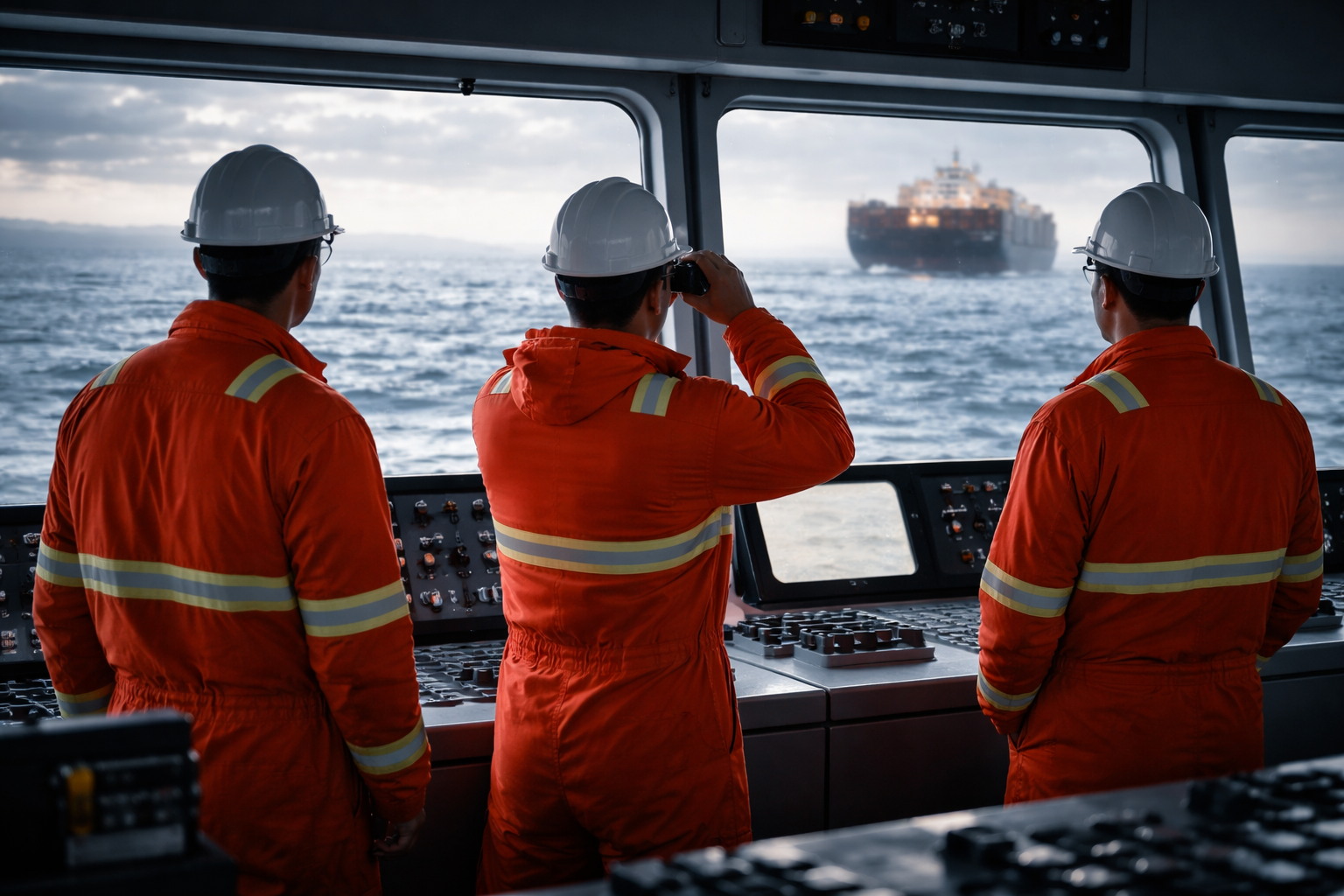
It’s 0300.
The ship is steady. Systems are running. Nothing is wrong.
But the officer at the console has been awake for six hours. The one before him was nine. Tomorrow’s schedule is already tighter than today’s.
He checks the display. Then checks it again not because something looked off, but because he isn’t sure he trusted himself the first time.
No one sees that moment.
No alarm records it.
No report captures it.
But it happened. And on ships around the world, tonight, it is happening again.
“The moments that matter most at sea are often the ones no one ever knows about.”
A Voice From Sea
A chief officer, reflecting after a difficult rotation, said this:
“You don’t realize how tired you are until the ship docks. At sea, you just keep going. You have to. But somewhere around week six, I noticed I stopped asking questions I would have asked in week one. Not because I knew the answers. Because I didn’t have the energy to wait for them.”
He wasn’t struggling.
He was functioning. But something had quietly shifted — and he only saw it looking back.
This is what sustained pressure does. It doesn’t break people. It slowly narrows them.
The Accumulation Effect — Pressure Over Time
Pressure is not just about intensity. It is about duration.
One long day is manageable. Several are expected. Weeks of sustained pressure begin to accumulate.
This is where impact begins to show:
- focus requires more effort
- patience becomes thinner
- communication becomes functional, not thoughtful
- mental fatigue becomes the baseline
“Pressure is not what you feel in a moment — it is what you carry over time.”
What Pressure Looks Like — And What It Doesn’t
Pressure at sea rarely looks dramatic.
It looks like:
- fewer conversations
- more direct instructions
- reduced engagement
- quiet withdrawal
It does not announce itself as stress. It blends into routine.
“The most dangerous pressure is the one that feels normal.”
Human Factor — When Performance Begins to Shift
Under sustained pressure, performance doesn’t collapse — it changes shape.
Attention narrows. Communication simplifies. Decisions accelerate. Recovery slows.
Each change is small.
But maritime safety depends on consistency across many moments.
“Safety is not lost in one action — it is shaped across many.”
Leadership Under Pressure — Becoming the Anchor
When pace increases and margins shrink, people look for something stable.
That stability is leadership. Not authority. Not control. But presence.
Leaders who make the difference:
- remain calm when urgency rises
- slow things down when needed
- listen even when time feels limited
- recognise pressure before it becomes visible
“In high-pressure environments, calm is not a personality — it is a responsibility.”
The Crew Dynamic — How Pressure Moves Through Teams
Pressure is not contained within one role.
It spreads — through tone, through communication, through reactions.
But so does resilience.
Crews that stay strong under pressure:
- maintain connection, even in busy moments
- support without needing instruction
- keep communication clear, even when short
- notice when something feels off
“Pressure spreads fast. So does support.”
Practical Focus — When Pressure Is High, These Things Matter
It is easy to talk about resilience in calm moments.
The real test is what happens when the schedule is tight, the shift is long, and the margin for error feels thin.
These are not rules. They are reminders for the moments when pressure is quietly winning.
For Those Who Lead
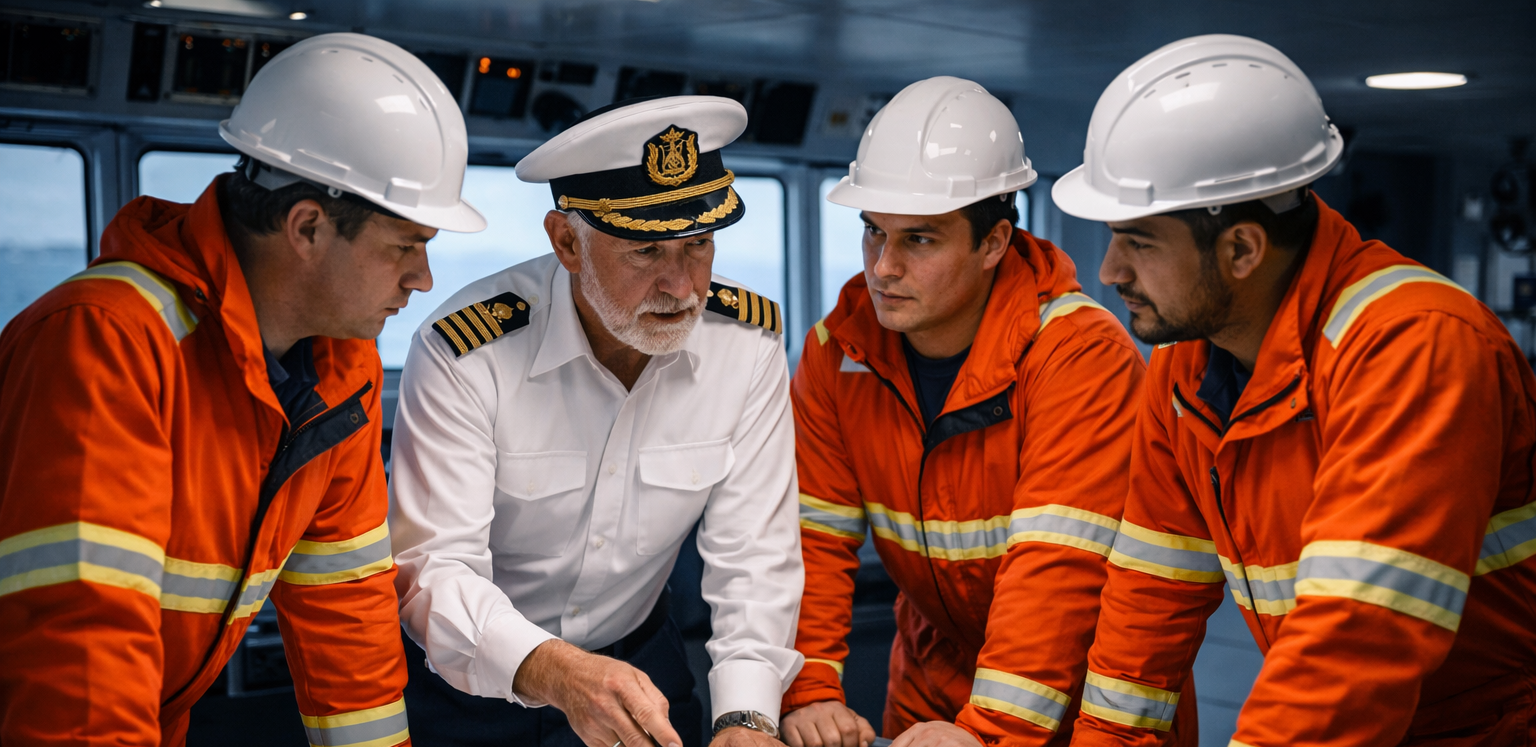
When pace increases, the instinct is to push harder. But the crew is watching — not just what you do, but how you carry it.
Speak clearly, especially when things are unclear. Uncertainty is manageable. Silence is not.
Look at people, not just performance. A result can look fine while a person is struggling. Notice both.
Be the pause in the room. When everything is accelerating, one moment of deliberate calm from a leader can reset the whole dynamic.
Name what is happening. Sometimes simply saying “I know this period has been demanding” does more than any process adjustment.
For Those Onboard
Pressure has a way of making you feel like slowing down is not an option. Often, it is the only one that matters.
Before you act — breathe. One second of awareness is worth more than ten seconds of correction.
Ask the question you almost didn’t ask. The moment you talk yourself out of speaking up is usually the moment you should.
Check in — not just on tasks, but on people. A brief “you alright?” costs nothing. What it prevents might be significant.
Don’t disappear into the work. Withdrawal feels like focus. Often it is the earliest sign that something needs attention.
“Under pressure, small actions carry more weight than they appear to. Choose them deliberately.”
A Brief Pause — Reclaiming Control
In the middle of pressure, control begins with awareness.
Pause, even briefly:
- Am I reacting or thinking?
- Has pressure changed how I’m responding?
- Do I need to reset before continuing?
“A few seconds of awareness can protect hours of consequence.”
Pressure Is Not the Problem. Isolation Is.
Pressure is not the enemy.
It has always been part of life at sea and the people who choose this profession know that.
What changes outcomes is not the absence of pressure. It is what surrounds a person when pressure is high.
Awareness — so it is recognised before it compounds.
Communication — so it doesn’t have to be carried silently.
Leadership — so there is something steady to hold onto.
Connection — so no one is managing it alone.
Pressure isolates. These things bring people back together.
“It is not the weight that breaks people. It is carrying it with no one beside them.”
Closing Reflection — The Weight Behind Every Voyage
Every voyage ends at port.
But the crew carries what happened at sea long after the lines are tied.
The extended hours. The quiet decisions. The moments of doubt that no one witnessed but everyone felt.
This is not weakness. It is the reality of work that the world depends on but rarely stops to understand.
If this resonates with what you see onboard or what you carry yourself we’d like to be part of the conversation.
At Strive-High, we work with maritime organizations to build the awareness, leadership, and crew support that makes a real difference under real pressure.
Reach out. The conversation doesn’t have to wait until something goes wrong.