


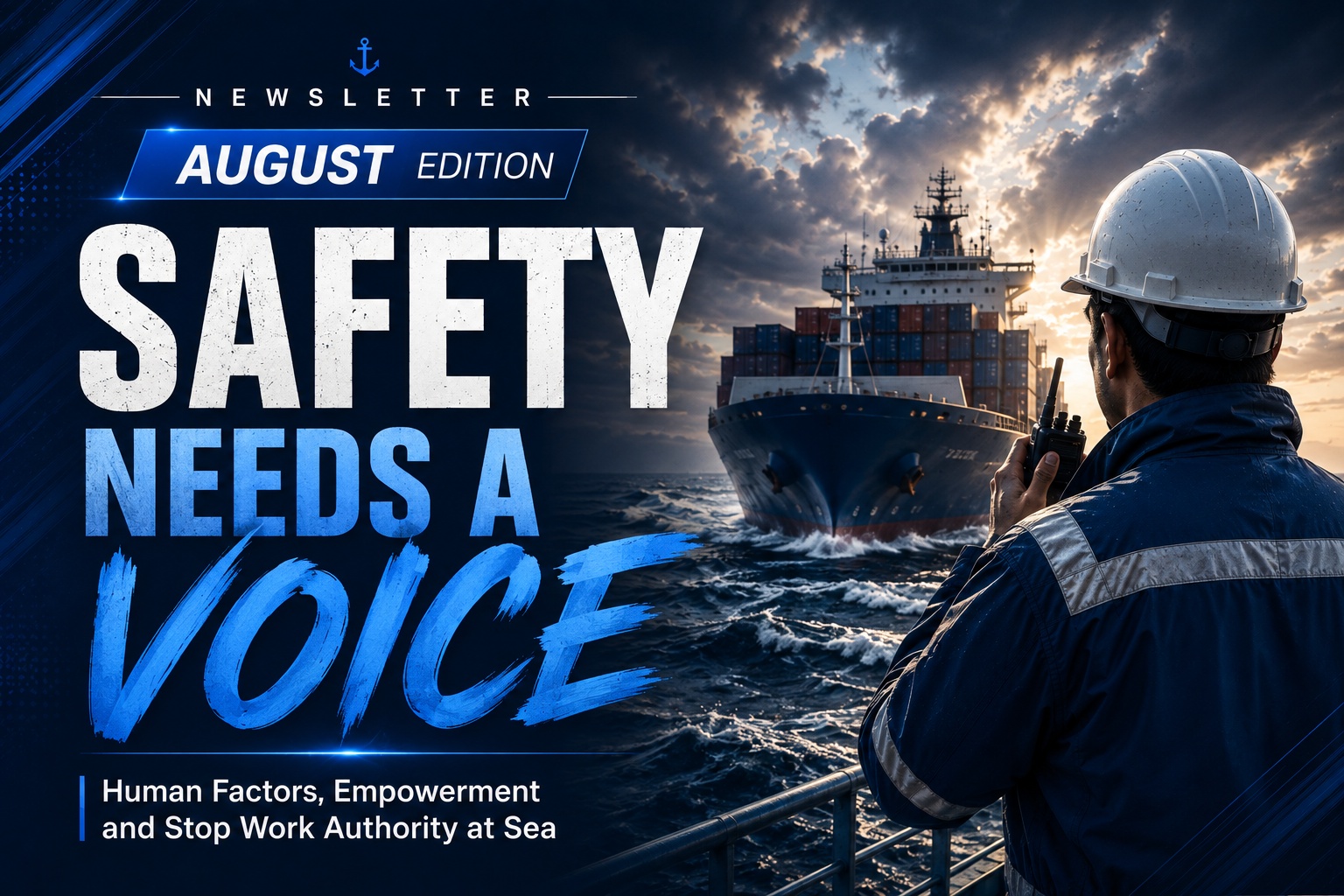
SAFETY NEEDS A VOICE- Human Factors, Empowerment and Stop Work Authority at Sea
A Note from the Editor
There are moments at sea when safety depends on something very simple: someone being willing to speak up.
A seafarer notices something that does not look right. A familiar task begins to feel unsafe. A precaution appears to have been missed. In that moment, the procedure may provide a clear answer: stop the work and raise the concern. But human behaviour is rarely that simple. Will the person feel confident enough to speak? Will they worry about interrupting the operation? Will rank or experience make them hesitate? Will they wonder how their concern will be received?
These questions sit at the heart of this month’s edition.
Stop Work Authority is an important part of a safety system, but its effectiveness depends on more than having a policy in place. It depends on the people expected to use it—and on the environment surrounding them.
A strong safety culture gives people more than permission. It gives them the confidence to question, communicate, and act when something feels unsafe. It also asks leaders to listen without defensiveness and organisations to create an environment where genuine safety concerns are treated as professional responsibility rather than disruption.
This edition of the Strive High Newsletter explores the human factors behind that process. We look at hierarchy, fear, leadership, communication, psychological safety, and the journey from compliance to culture. Because safety is not strengthened simply when procedures are written. It is strengthened when people feel safe enough to use them.
With more than a decade of experience working with maritime professionals, Strive High has continued to focus on the behavioural side of safety—helping people and organisations develop the capabilities that support stronger communication, better leadership, psychological safety, and safer performance.
We hope this edition encourages a simple but important reflection:
If you saw something unsafe today, would you feel confident enough to say, “Stop”?
Warm Regards,
Ms. Suganya Selvaraj
Marketing & Communications Manager
Strive High Pte. Ltd.
When Safety Depends on Speaking Up
A safety procedure can be clear. A Stop Work Authority policy can be written, communicated, and included in the safety management system.
But when an actual risk appears, the most important question is often much simpler: Will someone speak up? Imagine a routine task underway. A seafarer notices that something has changed—a precaution is missing, a condition looks different, or a step does not seem as safe as expected. They know they can raise the concern and stop the work if necessary. Yet there is a moment of hesitation.
The operation is already in progress. Others are busy. The person supervising the task has more experience. Perhaps the concern feels too minor to interrupt the work. That hesitation is a human factor. People do not respond to safety procedures in isolation. Their behaviour can be influenced by pressure, relationships, experience, hierarchy, habits, and what they have seen happen to others who speak up. This is why giving someone formal authority is only the beginning. They also need to believe that using that authority is acceptable.
“The greatest danger in times of turbulence is not the turbulence; it is to act with yesterday’s logic.”
A seafarer who feels respected is more likely to raise a concern. A leader who responds constructively makes it easier for the next person to do the same. Over time, these interactions shape whether Stop Work Authority becomes a genuine safety behaviour or simply another procedure people know exists.
The difference can be subtle.
A policy says: “You have the right to stop.”
A strong culture says: “We expect you to stop when something is unsafe—and we will support you when you do.”
That distinction matters because safety depends on information reaching the people who can act on it. The person closest to a task may notice something that others cannot. A concern raised early can create an opportunity to reassess before the situation develops further. Speaking up, therefore, is not about challenging authority for its own sake. It is about protecting the operation. And when every person understands that their voice has a legitimate place in safety, Stop Work Authority becomes more than a policy. It becomes part of how the crew looks after one another.
But having a voice does not always mean feeling free to use it. On a ship, rank and authority are essential to effective operations but they can also influence who feels comfortable questioning a decision. To understand why some voices hesitate, we need to look at the role of hierarchy.

When Rank Gets in the Way of a Voice
Hierarchy is essential at sea. Clear responsibilities and defined authority help crews coordinate complex operations and make decisions when time matters. Experience also matters; it allows people to recognise patterns, anticipate problems, and guide others through difficult situations.
But hierarchy can influence something less visible: whether people feel comfortable speaking up. A junior seafarer may notice a potential hazard but hesitate before raising it with a senior officer. An experienced crew member may question a familiar practice but decide that it is better not to challenge the person leading the task.
The concern exists. The knowledge exists. But the voice remains silent. This is not necessarily a failure of competence. It can be a response to the social environment around the person. People naturally consider how their actions might be received, particularly when there is a significant difference in rank, experience, or authority.
They may think: “Perhaps they already know.” “I don’t want to interrupt.” “What if I’m wrong?” “Will this make me look inexperienced?”
These thoughts can take only a few seconds, but those seconds can matter.
“The greatest ability in business is to get along with others and to influence their actions.”
— John Hancock
A healthy safety culture does not require removing hierarchy. It requires making sure that hierarchy does not prevent important information from moving through the organisation. The person with the highest rank may have the authority to make the final decision, but the person closest to the task may have the information needed to make that decision better. That is why speaking up should not be viewed as challenging authority.
It should be viewed as contributing to good judgement. Leaders have an important role in making this possible. When they actively invite questions, acknowledge concerns, and demonstrate that they value information from every level of the crew, they reduce the psychological distance between rank and voice. Over time, something important begins to change.
People stop thinking, “Should I say something?” They begin thinking, “I should say something.” That shift is one of the foundations of an empowered safety culture. But hierarchy is only one reason people remain silent. Even when a person knows they have the right to speak, another question may hold them back: “What will happen if I do?” The next part of our conversation looks at the fears that can turn a valid safety concern into silence.
The Fear Behind Silence
Sometimes, the hardest part of speaking up is not knowing what to say. It is deciding whether it is safe to say it at all. A seafarer may recognise a genuine risk and still hesitate. The concern might seem small. The operation may already be underway. Others may be watching. Or the person may simply worry about being wrong. There can be many reasons for that hesitation: fear of criticism, embarrassment, conflict, delaying the operation, or being perceived as inexperienced. None of these concerns appear in a safety procedure. Yet they can strongly influence behaviour.
“Courage is not the absence of fear, but the triumph over it.” This is why empowerment cannot stop at telling people, “You have the authority to stop the work.” People also need confidence that raising a concern will not result in blame or humiliation. Consider two different responses to the same intervention.
“Why did you stop the job? We have done this many times.”
Or:
“Thank you for raising it. Let’s understand what you noticed.”
The task may be the same. The procedure may be the same. But the lesson the crew receives is completely different. The first response can reinforce silence. The second can strengthen trust. Over time, these experiences shape whether people speak up the next time they notice something. A single interaction may seem insignificant, but repeated interactions become part of the culture.
This is where psychological safety becomes important. People do not need to feel comfortable all the time. Speaking up about a risk can still feel difficult. What matters is knowing that the organisation values the intervention and will respond fairly. And empowerment does not mean encouraging people to stop work without judgement. It means giving them the confidence to raise a genuine concern and the communication skills to explain it clearly.
The goal is not to remove fear completely. It is to ensure that fear does not make the decision for us. If people are more likely to speak when they trust how their concerns will be received, then leadership becomes part of the safety system itself. The next question is therefore simple: what do leaders do when someone speaks up?
When Leaders Listen, Safety Speaks Louder
A seafarer may have the confidence to raise a concern, but the real test of empowerment begins after the words are spoken. What happens next? A leader can respond with curiosity: “Tell me what you noticed.” Or the response can be dismissive: “We’ve done this before. It’s fine.” Both responses take only a few seconds. But they can leave very different impressions.
People remember how their concerns were received. When a leader listens, asks questions, and takes the concern seriously, the message is clear: speaking up is valued here. When concerns are dismissed or met with frustration, people may think twice before raising the next one.
“Listening is an art that requires attention over talent, spirit over ego.”
Good safety leadership does not mean agreeing with every concern or stopping every operation. It means creating enough space to understand the concern before deciding what to do. This becomes especially important when operations are under pressure. Tight schedules, workload, fatigue, or commercial expectations can make it tempting to prioritise keeping things moving. A leader who continues to welcome questions during these moments demonstrates that safety is not conditional on convenience.
There is another important part of leadership: how leaders respond when the person speaking is junior. A question from a cadet or rating should receive the same respect as one from an experienced officer when the subject is safety. The final decision may remain with the person responsible for the operation, but the information needed to make that decision can come from anywhere within the crew.
When leaders consistently listen, something changes. People become more willing to share observations. They become more comfortable asking questions. And gradually, speaking up becomes less of an exceptional act and more of an everyday safety behaviour. That is the kind of environment in which Stop Work Authority can truly work—not because people are simply told they have a voice, but because leadership demonstrates that the voice will be heard.
But confidence to speak and a willingness to listen are only two sides of the conversation. A concern still needs to be communicated clearly enough to be understood and acted upon. In the next section, we look at why speaking up itself is a skill and how the way we communicate can influence what happens next.
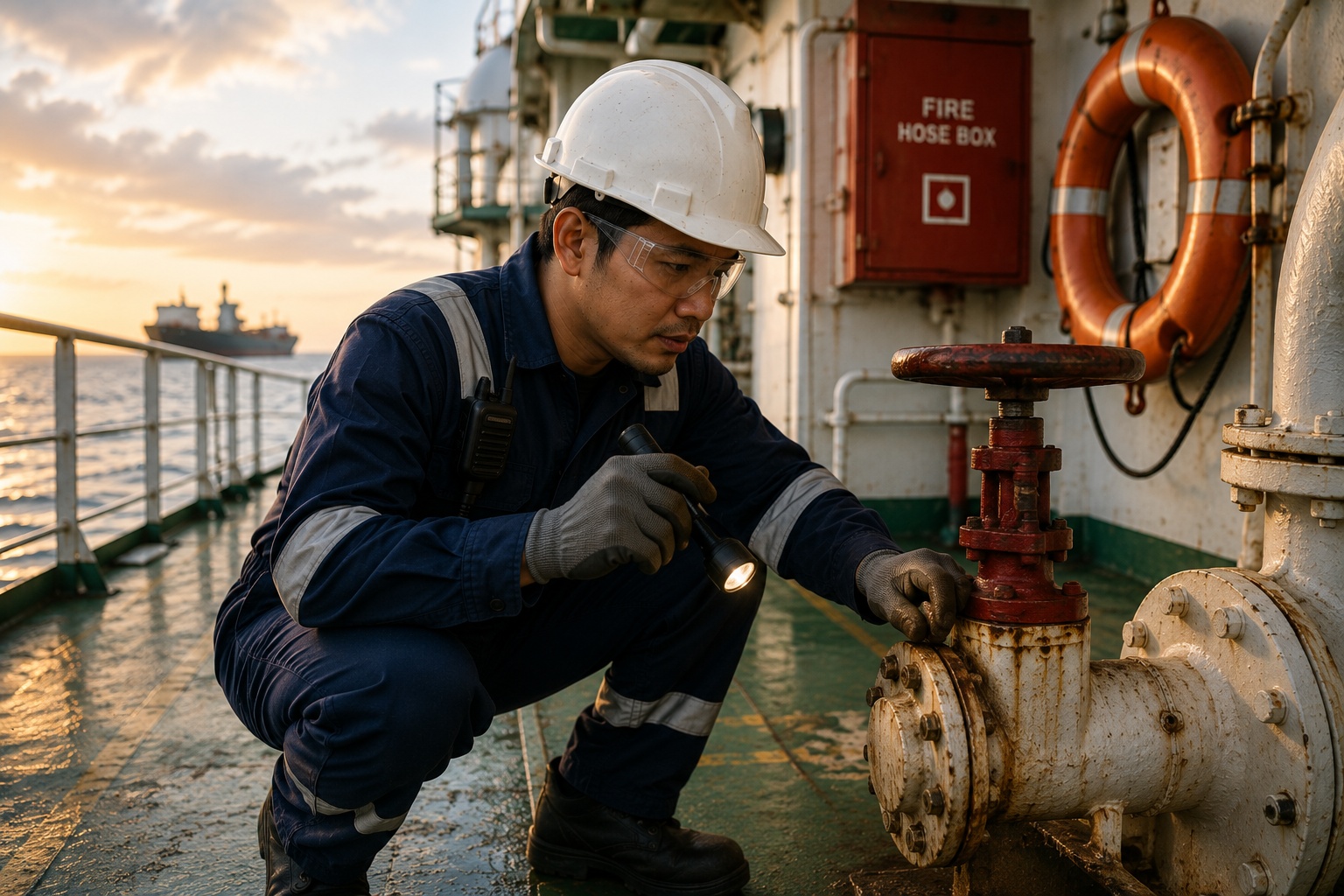
Speaking Up Is a Skill Too
Knowing that you have the right to speak up is one thing. Knowing how to do it effectively is another.
When a safety concern arises, the way it is communicated can influence how quickly it is understood and addressed. A rushed statement, an unclear observation, or language that sounds personal can unintentionally create defensiveness. A clear and respectful message can open the door to a productive conversation.
Consider the difference between: “You’re doing this wrong.” and: “I noticed a potential risk here. Can we take another look before we continue?” The concern is essentially the same. But the second approach keeps the focus on the risk rather than the person.
“The single biggest problem in communication is the illusion that it has taken place.”
— George Bernard Shaw
Effective safety communication begins with observation. What have you actually seen or heard? What has changed? What concerns you? Keeping the message specific helps others understand the situation without having to interpret assumptions. It also means choosing the right moment. Raising a concern early, before a task progresses further, gives the team more opportunity to respond. And when someone speaks, listening is equally important. Communication is not complete simply because the message has been delivered; understanding needs to be confirmed.
This becomes even more important within multicultural crews, where differences in language, communication style, and cultural expectations can affect how a message is interpreted. Clear language, active listening, and respectful questioning help reduce these barriers. Speaking up does not require confrontation. It requires clarity, confidence, and professional judgement. When these behaviours become part of everyday communication, raising a safety concern becomes less intimidating. People can challenge an unsafe situation without feeling that they are challenging someone’s dignity or authority.
And when speaking up becomes a normal part of communication, the organisation begins moving beyond individual interventions towards something more powerful: a culture where safety conversations happen before they become necessary.
A procedure can provide the framework. People can develop the confidence and communication skills to use it. But lasting safety depends on what happens repeatedly across the organisation. The next step is moving from compliance to culture—where speaking up is not an exceptional response, but part of how safety is practised every day.
From Compliance to Culture
A procedure can tell people what to do. A safety culture influences what people actually do when the situation becomes difficult.
This is where the difference between compliance and commitment becomes important. An organisation may have a Stop Work Authority policy, provide training, and make the procedure available to everyone. But the presence of a policy does not automatically mean people will feel confident using it. Culture is built through experience.
If a seafarer raises a concern and is listened to, trust grows. If a leader responds respectfully to a challenge, people become more comfortable speaking up. If a genuine intervention is treated as responsible behaviour rather than an inconvenience, the entire crew learns that safety comes before silence.
“What gets measured gets managed.”
But safety culture goes beyond what can easily be measured. It is found in everyday interactions: the questions asked during a toolbox talk, the response to a near miss, the way a junior seafarer is treated when they challenge something, and whether leaders remain open when operations are under pressure. That is why Stop Work Authority should not be viewed simply as a procedure to satisfy.
Its real value lies in creating an environment where people feel responsible for safety and confident enough to act on that responsibility.
The question therefore changes from:
“Do we have a Stop Work Authority policy?” to: “Do our people believe they can use it?”
That is the shift from compliance to culture. A compliant organisation can have the right documents. A strong safety culture creates the right behaviours. And when those behaviours become part of everyday work, speaking up no longer feels like an interruption. It becomes part of doing the job well. Moving from compliance to culture requires more than policies and procedures. It requires people who understand the human factors behind safety—and organisations willing to develop those capabilities. This is where Strive High’s experience of more than a decade in maritime behavioural skills becomes part of the conversation.
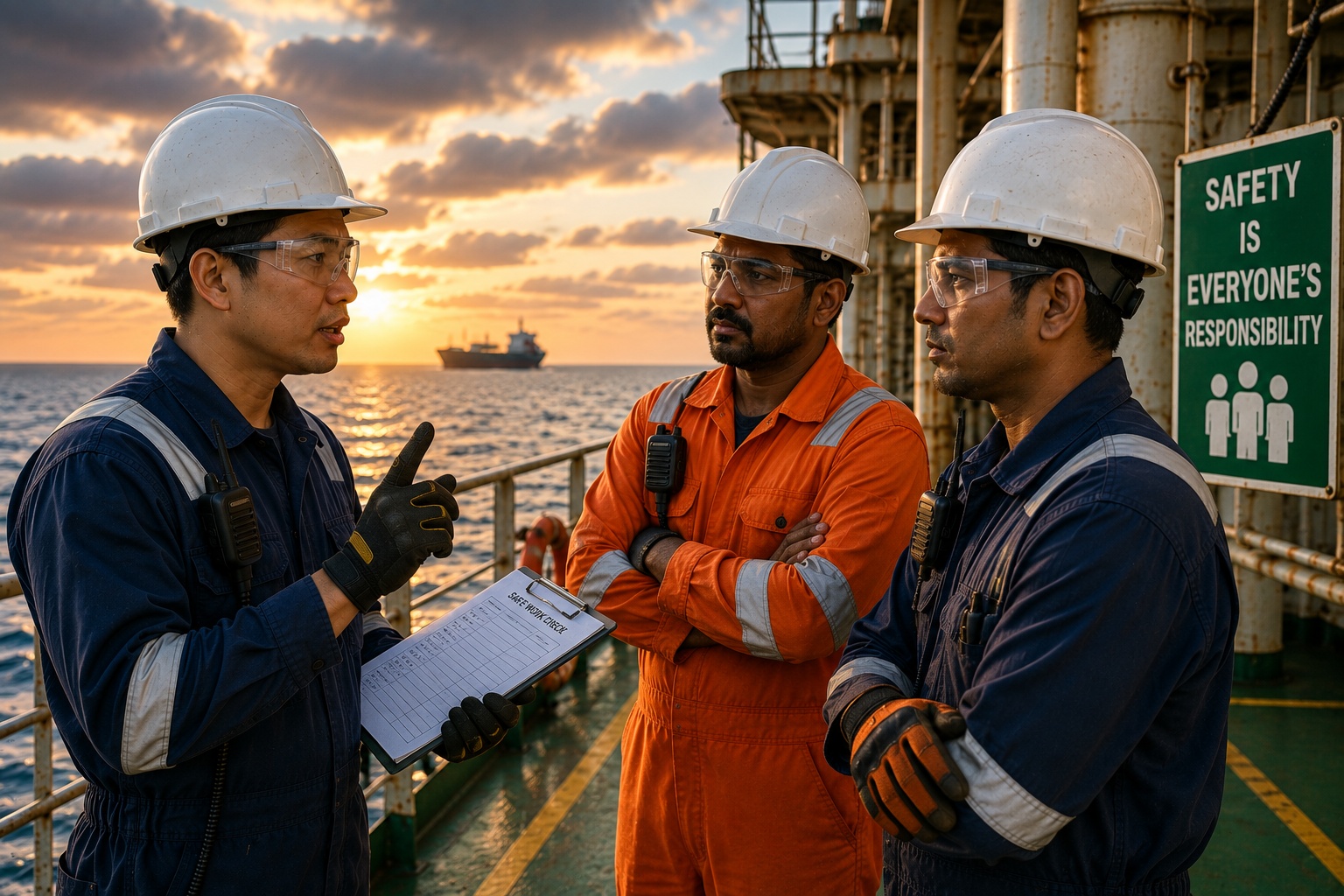
Strive High: From Awareness to Behaviour
For more than a decade, Strive High has worked alongside maritime professionals with a simple understanding: safer performance depends on more than knowing the rules. It depends on how people think, communicate, respond, and work together.
This is particularly relevant to Stop Work Authority. People may know that they have the right to intervene. But turning that knowledge into confident action requires more. Seafarers need the communication skills to raise concerns, the confidence to challenge respectfully, and the understanding of how human factors can influence decisions under pressure.
Leaders, in turn, need the skills to listen, respond constructively, and create an environment where people feel safe to contribute. That is where behavioural development becomes part of safety performance. Through our work in Human Factors, Behavioural Safety, Psychological Safety, Maritime Leadership, Communication, and Crew Wellbeing, Strive High focuses on the behaviours that sit behind the procedures. Our approach is not about replacing established safety systems. It is about helping the people within those systems understand, apply, and strengthen them through everyday behaviour.
Because awareness tells someone what matters. Training can show them what to do. But behaviour determines what happens when it really matters. After more than a decade in the maritime space, this remains central to our work: helping organisations move beyond awareness and towards practical behavioural change that supports stronger people, stronger crews, and safer working environments. A procedure can provide the authority. People make that authority work. And when people are equipped, empowered, and heard, safety has a much stronger voice.
The conversation ultimately comes back to one person, one observation, and one decision: Will I speak up? In our final reflection, we bring together the human factors behind that decision—and why creating space for every voice may be one of the most important investments a safety culture can make.
Every Voice Counts
A safety culture is often described through procedures, audits, training, and performance indicators. But beneath all of these is something much more human: what people feel able to say when it matters. A seafarer may notice a risk before anyone else. They may have a question that changes the way a task is approached.
They may be the person who says, “Something doesn’t look right.” That moment matters. Not because the person is necessarily correct every time, but because speaking up creates an opportunity to pause, assess, and make a better decision. Stop Work Authority gives people a formal mechanism to intervene. But trust, leadership, communication, and psychological safety determine whether that mechanism becomes part of everyday behaviour.
The strongest safety cultures therefore do not simply ask people to follow procedures. They create an environment where people feel responsible enough to speak and safe enough to be heard.
“Safety is not a destination. It is a continuous journey.”
For leaders, this means listening even when the message is inconvenient. For crew members, it means having the courage to raise a genuine concern respectfully. For organisations, it means recognising that behavioural capability deserves the same attention as technical competence.
Because every procedure ultimately depends on a person. Every decision depends on judgement. And every safety culture is shaped by the conversations people are willing to have. After more than a decade of working with maritime professionals, Strive High continues to believe that strengthening the human side of safety is not an additional layer—it is an essential part of making safety systems work as intended.
The next time someone speaks up, perhaps the most important response is not: “Why did you stop?” but: “Thank you for noticing. Let’s take a look.” Because when people know their voice matters, they are more likely to use it. And when every voice has a place in safety, the whole crew becomes stronger.
Safety needs a voice. Make sure yours can be heard.